Agentic Commerce: How Shopify Merchants Can Sell Through AI Shopping
Agentic commerce lets AI tools help people discover, compare, and buy products, shifting parts of online shopping from store pages to conversational interfaces. For Shopify merchants, the practical opportunity is to make accurate product information and a dependable buying experience available wherever customers ask an AI for help—including ChatGPT, Google Search’s AI Mode, and Microsoft Copilot, as supported features roll out.
Key Takeaways- Agentic commerce describes shopping in which AI assists with product discovery, comparison, and, in some cases, purchasing.
- It does not make a merchant’s website, product data, or customer service irrelevant; it raises the cost of getting those basics wrong.
- Shopify merchants should start with clean product data, reliable inventory and pricing, clear policies, and a checkout that works on mobile.
- Treat AI shopping as a sales channel to measure, not a magic faucet. Availability and buying features can vary by platform, market, and merchant eligibility.
- Protect customer trust: disclose material terms, make returns understandable, and do not use misleading claims to win an AI recommendation.
What Is Agentic Commerce?
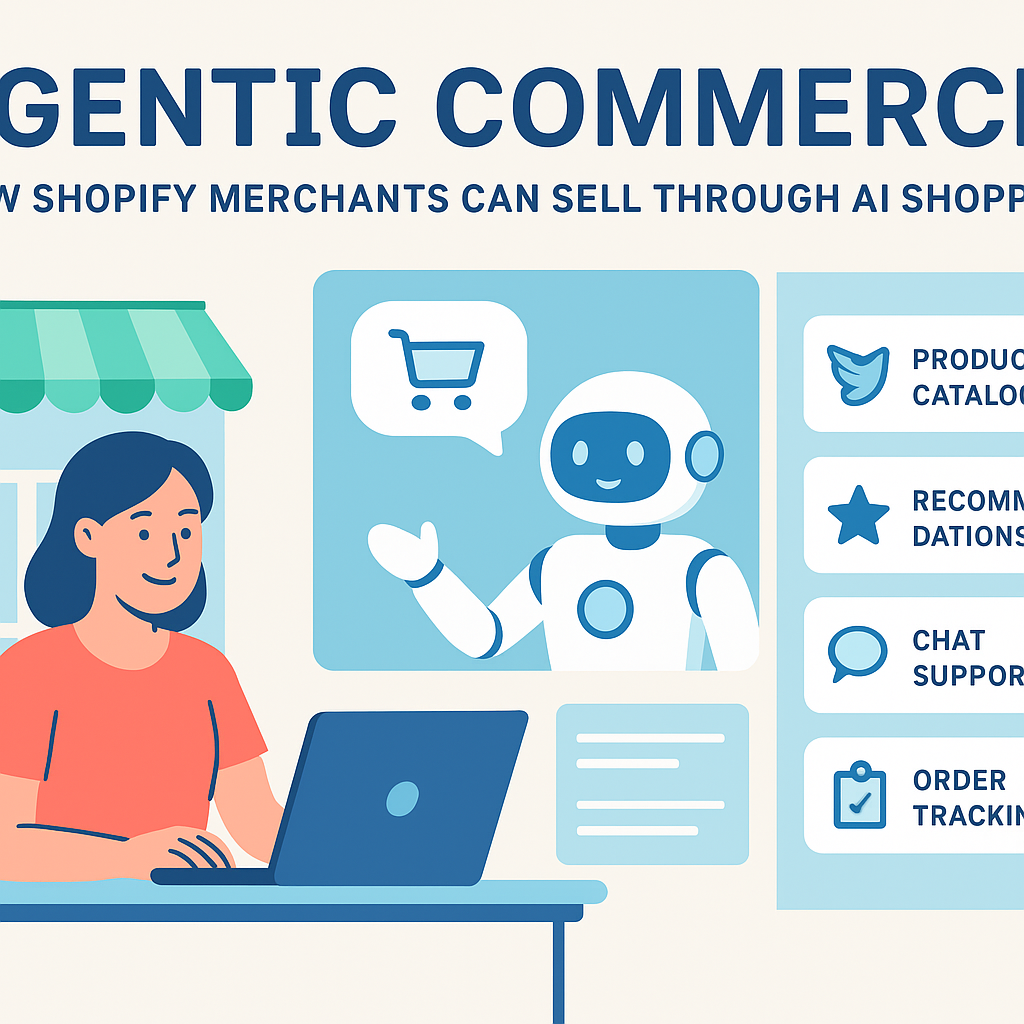
Agentic commerce is a way of shopping in which a software agent performs or supports tasks that people once did by visiting several retail websites themselves. A shopper might describe what they need, set a budget, ask for alternatives, and receive product suggestions from an AI assistant. Depending on the product and platform, the assistant may then guide the shopper to a retailer or support a purchase within the conversation.
That range matters. A tool that answers product questions is not automatically a fully autonomous buying agent. Some experiences mainly summarize options and link to a product page; others may support a more direct transaction. The shopper still sets the goal, and the retailer remains responsible for its product, fulfilment, customer service, and applicable policies. Calling every AI-assisted product search “agentic” can make the idea sound more advanced than the customer experience actually is.
For Shopify merchants, the central issue is whether product information can be understood and used by these new interfaces. A product listing needs more than a clever name and a pretty photograph. It needs accurate titles, descriptions, variants, price, availability, shipping details, return terms, and information about who the product is for. If the feed says a size is in stock when it is not, an AI may repeat the bad information with great confidence. That is not progress; it is a faster way to disappoint someone.
Shopify Staff’s April 30, 2026 article describes merchant selling through ChatGPT, AI Mode in Google Search, and Copilot. The important strategic point is channel access: customers may encounter a product while asking an assistant for help, rather than while typing a retailer’s name into a browser. Exact functionality, eligibility, and checkout arrangements should be checked against current platform and Shopify documentation because rollouts can differ by country, account, and product category.
I assess commerce technology by asking a plain question: does it reduce friction for customers without hiding who is selling, what something costs, or what happens after the order? That standard is more useful than breathless predictions. A conversational interface can make shopping easier, but it cannot turn a weak product, unclear policy, or unreliable operation into a good business.
Why Agentic Commerce Matters to Merchants
The strongest case for agentic commerce is not that every shopper will suddenly buy from a bot. It is that product discovery is spreading across more interfaces, and merchants may benefit when their catalog can be found and compared in those places. That is an extension of digital merchandising, not a replacement for it.
- More routes to discovery. A shopper may ask an assistant for a durable carry-on under a certain price, or a gift suitable for a new parent. If the product data clearly explains size, materials, use, and price, the item has a better chance of being matched to the request. There is no guarantee of a recommendation; relevance and platform rules still matter.
- Less effort for comparison. An assistant can help a customer sort options by budget, features, or stated preferences. That can reduce repetitive browsing, especially for products with many variants. It can also make a weak specification sheet painfully obvious.
- Potentially shorter paths to purchase. Some systems may let shoppers move from a recommendation toward checkout with fewer steps. The actual path depends on the channel’s features and the merchant’s setup. Do not assume every AI conversation ends with an order.
- A reason to improve catalog quality. Better product descriptions, structured attributes, and current availability help more than AI. They also support search, accessibility, customer service, and conversion on the merchant’s own store. This is useful work even if a platform changes its mind next quarter.
- A new source of performance data. As platforms expose referrals or reporting, merchants can compare visits, conversion, order value, returns, and support contacts by channel. The right measure is profitable, satisfied customers—not a screenshot of a product appearing in an AI answer.
Here is the kicker: a new channel can create reach while reducing a merchant’s control over presentation. An AI assistant may summarize a product in language the retailer did not write, compare it with competitors, or omit details that matter. Merchants therefore need accurate source information and a recognizable destination, while accepting that not every customer will see the brand in exactly the same way.
Commerce also carries obligations. A seller should not inflate claims, conceal recurring charges, or make returns difficult just because an interface is unfamiliar. Good stewardship means treating customer data, inventory, and advertising budgets as resources that require care. Human dignity is not a conversion tactic; it is a sensible standard for serving people who are spending their own money.
How Shopify Merchants Can Prepare: A Step-by-Step Guide
- Decide what success means before adding a channel.
Write down the business problem you want to solve. Are you trying to reach shoppers who do not know your brand, shorten product research, improve sales of a particular catalog range, or learn whether AI referrals convert? Pick one or two measurable aims. Set a baseline for direct and organic traffic, conversion rate, average order value, gross margin, returns, and customer-service volume.
I would not begin with a target like “be everywhere in AI.” It is too vague to guide spending. Start with a test that could change a decision, such as whether a small set of products receives qualified visits from a new source. Give the test a time period and a budget. If reporting is unavailable, say so plainly and use whatever reliable signals you do have rather than inventing attribution.
- Clean up the catalog.
Review product titles, descriptions, variant labels, images, price, stock status, shipping information, and return terms. Remove contradictory claims and stale promotional language. Explain dimensions, materials, compatibility, care instructions, and intended use where those details influence a purchase. Use consistent units and clear names for sizes or colors.
The goal is not to stuff descriptions with every search phrase a marketer can imagine. It is to make the product understandable to a person and to software that may summarize it. “Premium bottle” says very little; capacity, material, lid type, and care instructions say more. Keep the strongest claims supportable. If a product is handmade, certified, or made from a particular material, be prepared to substantiate that statement.
- Check the source of truth.
Make sure the store, inventory system, product feeds, and any connected sales channels agree about price and availability. A customer who sees one price in an assistant and another at checkout has every reason to leave. Confirm how discounts, taxes, shipping estimates, subscriptions, and out-of-stock variants are represented. Test common edge cases, including a product with multiple sizes and an item that has just sold out.
Shopify merchants should review the current Shopify documentation and the requirements of each platform they intend to use. Do not infer that a feature mentioned in an announcement is enabled for every store. Check eligibility, supported markets, product restrictions, setup steps, and checkout behavior before promising a capability to customers.
- Make the store trustworthy when the shopper arrives.
An AI referral is still a visit from a person. Keep navigation understandable, show contact details, explain delivery and returns, and make mobile checkout usable. A shopper should be able to verify what is in the cart, the total cost, and the seller’s identity. If the platform supports a purchase flow that does not send the shopper through the usual store pages, review how order confirmation, support, refunds, and customer records will work.
Clear policies do not merely prevent complaints. They help customers make informed decisions and help the business avoid costly misunderstandings. If a product has limitations, state them where they matter. Hiding a caveat until after checkout is a poor way to earn a second purchase.
- Protect privacy and review permissions.
Understand what information is shared with each platform, what the platform collects, and what the merchant receives. Limit access to staff and tools that need it. Follow relevant privacy, consumer-protection, and data-security requirements; do not send sensitive customer details to an unapproved service because a demonstration looked convenient. Review vendor terms and data-processing arrangements before connecting systems.
Treat customer permission as a real constraint, not a box to tick after the technical setup. If a service stores or uses information in a way customers would not reasonably expect, reassess the design and disclosures. The fact that an AI can process data does not mean the business should hand it everything.
- Run a small, disciplined experiment.
Choose a manageable product group, confirm the customer experience from discovery through fulfilment, and record the test period. Track available referrals, conversion, order value, gross margin, cancellations, returns, and customer questions. Compare results with similar products or a prior period, while noting seasonal changes and promotions that may distort the comparison.
When I evaluate a channel, I care about contribution after costs, not traffic alone. A flood of poorly matched visits can consume support time and advertising budget without improving profit. If the platform provides little attribution, document the limitation and avoid pretending that a correlation proves causation.
- Keep improving from real customer friction.
Review questions, abandoned checkouts, returns, and support conversations. If people repeatedly ask whether an item fits a particular device, add a compatibility table. If customers misunderstand the delivery window, rewrite it. If a product is often returned because its dimensions are smaller than expected, make the measurements easier to find and show scale clearly.
The best preparation for AI-assisted shopping is often ordinary good retail. Accurate information, dependable operations, fair policies, and a product worth buying will serve customers whether they arrive through a chatbot, a search result, or a friend’s recommendation.
Agentic Commerce vs. Traditional E-commerce
| Factor | Agentic commerce | Traditional e-commerce |
|---|
| Product discovery | Shopper may describe needs to an AI, which can suggest or compare products from available information. | Shopper searches a retailer’s site, uses a search engine, follows an ad, or visits a product page directly. |
| Main interface | Conversation or AI-generated results may shape the decision. The exact interface depends on the platform. | Retailer website, marketplace listing, or conventional search result. |
| Merchant control | Less control over how an intermediary summarizes or orders product information; the merchant still controls its underlying offer and service. | More control over the store’s page design and product presentation, though external search and marketplaces still influence discovery. |
| Product information | Clean, consistent catalog data is important because systems may use it to match requests and summarize options. | Good product information matters for search rankings, customer confidence, accessibility, and conversion. |
| Purchase path | May send shoppers to a store or support a more integrated flow where available. Do not assume one universal checkout model. | Usually proceeds through the retailer or marketplace checkout. |
| Measurement | Reporting and attribution may vary by platform and may be incomplete. | Established analytics are available, though attribution is still imperfect across devices and channels. |
| Merchant’s first move | Verify eligibility, product data, policies, checkout, and reporting for the specific platform. | Improve merchandising, traffic acquisition, conversion, fulfilment, and customer retention. |
The two models are not enemies. A merchant can maintain a strong online store while making its catalog usable in emerging AI interfaces. The practical trade-off is between reaching people in more places and accepting that an intermediary may influence the conversation. For useful background, Shopify’s Storefront API documentation explains one part of how storefront data and commerce experiences can be built; Google’s product data specification shows why precise, consistent product attributes matter in shopping surfaces. These are technical references, not a promise that any particular agent will display every product.
Common Mistakes to Avoid
Assuming the announcement means automatic access. Product availability, eligibility, and transaction features can change. A headline is not a setup guide. Confirm the current requirements with Shopify and the platform, then test the customer experience yourself before advertising that your products can be purchased in a particular way.
Treating AI recommendations as guaranteed placement. Merchants cannot simply pay for a guaranteed organic recommendation unless a platform explicitly offers and labels a paid placement. Do not buy services promising secret access or certain inclusion. Ask what the service actually changes, what data it needs, and how its claims are measured.
Writing for a machine instead of the buyer. Keyword-heavy copy, repeated phrases, and unsupported superlatives make a catalog harder to trust. Explain the product plainly. State what it does, who it suits, what it does not do, and what comes in the box. A real specification beats an inflated adjective.
Ignoring costs and margin. A new channel can add fees, fulfilment demands, returns, support work, and operational complexity. More orders are not automatically better orders. Calculate contribution margin after discounts, payment costs, fulfilment, refunds, and other channel-specific expenses. If the numbers do not work, a bigger audience only makes the leak wider.
Leaving customer service out of the plan. A recommendation engine does not answer a complaint about a late delivery or a damaged item on the merchant’s behalf unless an arrangement clearly says it will. Define who handles questions, cancellations, returns, and refunds. Make sure customers can reach the responsible seller without detective work.
Overlooking privacy and consumer protection. Data collection should be limited to what the business needs and handled according to applicable rules. Claims must be truthful, terms must be visible, and customer reviews or endorsements must not be manipulated. The U.S. Federal Trade Commission’s endorsement guides are a useful reminder that new interfaces do not excuse deceptive marketing. Merchants outside the United States should check the rules that apply in their own markets.
Confusing a technical connection with a business strategy. Connecting a feed or app may make products available to a surface; it does not establish demand, profitable economics, or customer loyalty. Keep investing in the brand, quality, merchandising, email permission, and service that remain yours to manage. Otherwise, the business risks renting all of its customer relationships from channels it cannot control.
Frequently Asked Questions
What is agentic commerce in simple terms?
It is shopping in which AI helps a person find, compare, or sometimes buy products. The shopper describes what they need, and an AI interface may use product information to offer options or guide the transaction. The degree of automation varies: some tools mainly answer questions and link to a store, while other experiences may support a more integrated purchase. The retailer remains responsible for its offer and fulfilment.
How can Shopify merchants sell through ChatGPT, Google AI Mode, or Copilot?
They should first check current Shopify and platform documentation for availability, eligibility, supported locations, product requirements, and checkout details. Then they should keep their catalog, pricing, inventory, and policies accurate and test the buying path from the customer’s point of view. Shopify Staff’s April 30, 2026 article identifies ChatGPT, Google Search’s AI Mode, and Copilot as relevant shopping surfaces, but merchants should not assume every feature is live for every store or market.
Is agentic commerce the same as social commerce?
No. Social commerce usually describes product discovery or purchasing through social platforms and creator-driven content. Agentic commerce centers on AI systems that interpret a shopper’s request and assist with product selection or purchase. The two can overlap if a platform combines social content, recommendation tools, and transactions, but they describe different mechanisms. Both still depend on accurate product details and trustworthy service.
Will AI shopping replace online stores?
There is no sound basis for assuming that it will. AI may alter how customers discover products and may shorten some buying paths, but merchants still need product pages, checkout operations, fulfilment, returns, and customer support. A store also gives a business a place to explain its products and serve repeat customers. The sensible move is to prepare for another discovery channel without neglecting the channels and relationships that already work.
Final Thought
Agentic commerce deserves attention, not worship. AI shopping can put a product in front of someone who might never have found the merchant through an ordinary search, and it may make comparison less tedious for a customer with a clear need. But the underlying business has not changed as much as the interface. People still want a product that does what it claims, a price they can understand, delivery that matches the promise, and a real remedy when something goes wrong.
For Shopify merchants, the sensible order is simple: improve product data, verify the operational details, learn what each platform actually supports, and run a measured test. Do not reorganize the whole business around a feature that is still rolling out or treat AI visibility as a substitute for demand. Make the catalog legible, keep the checkout honest, and measure whether the channel brings profitable orders and satisfied customers.
I would rather see a small merchant serve a hundred customers well than chase a fashionable channel while its inventory is wrong and its return policy is buried. That is not anti-technology; it is a reminder that technology is useful when it helps people do worthwhile work and make informed choices. If AI becomes a meaningful route to customers, build on it carefully. If it does not, the improvements you made to clarity, service, and trust will still pay their way.