A membership site sells continuing access to resources, instruction, or community for a recurring fee. It can turn scattered course sales into steadier...
How to Build a Membership Site for Reliable Online Income
A membership site sells continuing access to resources, instruction, or community for a recurring fee. It can turn scattered course sales into steadier revenue, but only when it solves a clear problem for a specific audience. The work is not passive at first: good retention depends on useful content, honest billing, and regular attention to what members need.
A membership can be a side hustle, a full-time digital business, or one revenue stream beside consulting and course sales. It may also create more predictable income than a string of launches, though no subscription can guarantee stable revenue when members are free to leave. Frankly, calling it passive income without mentioning support, updates, billing questions, and churn is a sales pitch, not an operating plan.
The useful question is not whether recurring revenue sounds attractive. It is whether people have an ongoing problem that your expertise can help them solve month after month. Start there, then choose a delivery system that reduces administrative work rather than creating a new pile of it.
What Is a Membership Site?
A membership site gives paying members ongoing access to something they value. That might include a course library, monthly workshops, downloadable templates, expert feedback, a private discussion space, or a combination of those items. Members usually pay monthly or annually, and the business continues delivering value while their subscription remains active.
The key difference from a single digital product is the relationship over time. A course can teach a defined skill once; a membership usually supports a continuing need, such as practicing that skill, applying it to changing circumstances, or getting answers when new obstacles appear. A library of videos alone is not automatically a membership offer. If customers can get the whole benefit in one weekend and then have no reason to return, recurring billing may feel like a poor deal.
The business model has several moving parts. Revenue streams may include monthly and annual plans, a higher-priced coaching tier, or separate course sales. Automation can handle payment reminders, access changes, receipts, and routine account updates. Scalability comes from serving more people without increasing delivery costs at the same rate, but support and content still require time. ROI depends on the price, acquisition cost, payment fees, refunds, taxes, and how long members stay.

When I evaluate a membership idea, I start with the member’s recurring problem, not the creator’s enthusiasm for making videos. The U.S. Small Business Administration recommends researching customers and competitors before committing to a business plan; its market research and competitive analysis guide is a sensible place to begin. What do people already pay to solve? What remains frustrating after they buy?
A practical membership promise should describe who it serves, the result it supports, and the rhythm of delivery. For example, a membership could help independent designers find qualified clients through monthly portfolio reviews, practical pricing lessons, and a live question session. That is more concrete than promising an endless vault of creative inspiration. Specific beats sprawling.
Core Benefits and Importance
Recurring billing can smooth revenue. It does not make income certain. A membership with 150 active members paying $40 per month has $6,000 in monthly gross billings before fees, refunds, taxes, and expenses. That base can be easier to plan around than starting each month from zero, but it shrinks if cancellations outpace new enrollments.
The biggest benefit is a closer feedback loop. You can hear where members get stuck, which resources they use, and what they need next. A one-time course seller may only see a purchase and a refund request; a membership operator has more chances to learn from real behavior. Use that access respectfully. Members are people paying for help, not an endless research panel.
A membership can also support several offers without requiring a new audience for each one. A basic tier might include a course library and monthly group session, while a higher tier adds small-group coaching. A standalone course can remain available at a separate price for customers who want a defined lesson and no ongoing subscription. That combination creates different paths to buy without forcing every customer into the same format.
There are useful business advantages:
- Revenue visibility: Active subscriptions make near-term planning less dependent on launch dates, although churn and payment failures still affect cash flow.
- More repeated contact: Members can build habits and apply material over time rather than receiving a single course and disappearing.
- Room for product improvement: Questions, attendance, and usage can show which lessons deserve updating and which features collect dust.
- Multiple pricing options: Monthly, annual, and tiered plans can suit different budgets and levels of support, provided each tier has a clear purpose.
- More resilient revenue mix: Memberships can sit alongside services, sponsorships, consulting, or individual products instead of carrying the whole business.
Here’s the kicker: a membership is not automatically better than a course. It asks you to keep earning the renewal. If your useful expertise fits into a complete, self-contained product, a one-time course may be fairer to the customer and simpler to operate. If the problem keeps returning or the material changes frequently, ongoing access may make more sense.
A sound membership also respects the dignity of members’ work and money. Explain what is included, make renewal terms plain, and let people manage their accounts without a scavenger hunt. Good stewardship is not only about protecting your time; it includes delivering a real benefit for the price.
Step-by-Step Guide to Building a Membership Site
1. Pick one audience and one ongoing problem
Write a plain sentence describing the member and the outcome. “I help new managers lead their first one-to-one meetings with confidence” is easier to test than “leadership content for everyone.” A narrower promise gives you a clearer way to find prospective members and decide what belongs in the offer.
Talk to people who match the audience before you build. Ask what they have tried, what still causes trouble, how often the problem comes up, and what they currently spend to address it. The SBA’s guidance on market research outlines ways to examine demand and competitors. Do not treat a friendly “that sounds great” as proof of willingness to pay; ask for a concrete commitment, such as joining a paid pilot.
2. Check whether the problem needs recurring help
A monthly payment should match a continuing benefit. List what changes from month to month: new questions, regular practice, fresh industry information, feedback, accountability, or access to expert help. If you cannot name a reason a member would still benefit in month four, reconsider the format.
This is where many creators confuse a topic with a business model. “Personal finance” is a broad topic. Helping people with a specific income and debt situation build a realistic payoff plan, review progress, and adjust when costs change is a more ongoing problem. The narrower version gives a member a reason to return.
3. Design a small, understandable offer
Start with one main tier unless customer research gives you a strong reason to add more. Too many plans make the purchase harder and create extra support work. State who the tier is for, what access it includes, how often new material arrives, and what it does not include.
You might bundle a course library, one live workshop per month, and a set of downloadable worksheets. A higher tier could add a group coaching session if you can reliably deliver it. Be careful with “unlimited” access to your time; it can turn a tidy side hustle into a queue of private requests. Price for the actual workload and member benefit, not for a competitor’s headline number.
4. Choose a platform before writing code
Compare platforms on recurring billing, access control, tier management, cancellation and account self-service, email integration, reporting, and support. Check whether the service calculates or collects relevant taxes, and read what remains your responsibility. Features differ by plan and country, so verify current terms rather than trusting a feature checklist from a year-old review.
A tool may process subscription payments without taking responsibility for every tax return, registration, or consumer-law requirement. The IRS Self-Employed Individuals Tax Center explains U.S. federal tax resources for self-employed people, but your obligations depend on your situation and location. If you sell internationally or have questions about tax treatment, get qualified advice. Software can reduce repetitive tasks; it cannot make legal responsibility disappear.
Stripe’s documentation explains how subscription billing can manage recurring payments and related billing events. Review its subscriptions overview as one example of the billing mechanics to understand. A payment processor is not necessarily a complete membership platform, so confirm that your full stack also handles learning content, member access, cancellation, and support.

5. Prepare the first month before opening the doors
Have enough ready that a new member can get value immediately. That might mean a short start-here lesson, a clear orientation, the first workshop date, and the first useful resource. Do not promise a huge library just to look established. A compact, well-organized starting point is better than an impressive archive members cannot use.
Set a release schedule you can sustain. One useful monthly workshop or resource, delivered on a predictable date, is often stronger than a frantic burst of weekly content that stops after six weeks. Tell members what is coming and when. Reliability is part of the product.
6. Set up the member experience and policies
Test the entire path as if you were a paying customer: sign-up, receipt, login, content access, password reset, plan change, cancellation, and confirmation. Make the renewal frequency and price visible before payment. Put support contact details where members can find them, and say how quickly you usually respond.
Cancellation should not require a negotiation. The U.S. Federal Trade Commission’s guidance on negative-option marketing explains important considerations for subscription and renewal practices. Rules vary by jurisdiction and can change, so treat this as a starting point rather than legal advice. Clear terms and a straightforward cancellation path are good business even where a particular rule does not require them.
7. Invite warm prospects, then measure retention
Start with people who already know your work: relevant email subscribers, past customers, or a small group who participated in research. Explain the promise, price, schedule, and cancellation terms without puffery. You can offer founding pricing if it is real, clearly described, and limited for a genuine reason, such as a small pilot group that receives direct feedback access.
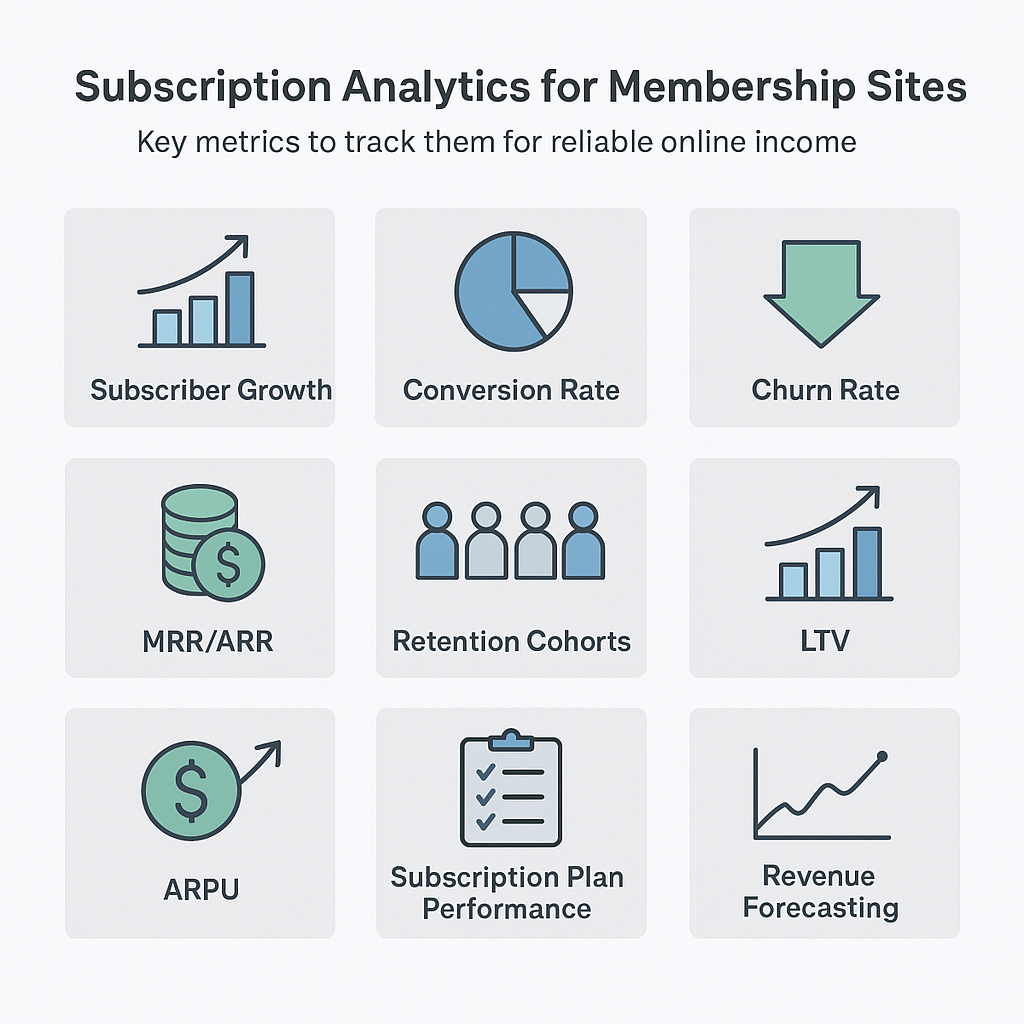
Track the basics from day one: active members, new paid members, failed payments, cancellations, refunds, and the reasons people leave. Calculate churn consistently. For example, if 10 members cancel from a base of 200 at the start of a month, simple monthly member churn is 5 percent for that period; define how you handle pauses, failed payments, and new sign-ups so comparisons stay useful. Watch engagement too, but do not mistake logins for outcomes.
When I assess a launch, I look for evidence that people receive value and choose to stay, not a dramatic first-week sign-up count. Retention is the test. Ask departing members one respectful question about why they left, then look for repeated patterns instead of rebuilding the whole product around one person’s request.
Membership Site vs. Standalone Online Course
The closest competitor to a membership is often a one-time online course. Both can sell expertise, recorded instruction, and downloadable resources. The difference is how the customer pays and what the business promises to keep delivering.
| Factor | Membership site | Standalone online course |
|---|
| Payment pattern | Monthly or annual recurring charge | Usually a one-time purchase |
| Main promise | Continuing access, support, updates, or community | A defined body of instruction or outcome |
| Revenue behavior | Can build a recurring base, reduced by churn and failed payments | Revenue depends on each new sale or launch |
| Ongoing workload | Content, member support, billing questions, retention | Updates and support vary, but there may be no monthly release schedule |
| Best fit | A problem that returns or changes over time | A skill or topic that can be taught as a complete unit |
| Example gross billings | 150 members × $40 monthly = $6,000 for that month | 50 sales × $120 = $6,000 for that month |
The numbers are a simple illustration, not a forecast. Both examples show $6,000 in gross sales for the stated month, but they do not represent equal effort, profit, or future revenue. The membership figure assumes all 150 payments succeed; it excludes fees, refunds, taxes, and service costs. The course figure also excludes those costs and requires another set of sales to repeat next month.
The membership model can make revenue more visible, but it adds a retention job. The course model gives a cleaner transaction, but the creator may need fresh sales activity to maintain income. Some businesses sensibly sell both: a course for self-directed learners and a membership for people who want regular guidance. Let the customer’s need decide the format, not a fashionable claim about recurring revenue.
Common Mistakes to Avoid
Building the software before confirming demand. People can lose weeks adjusting payment plugins, colors, and tier names before asking prospective members what they need. Build the smallest credible offer first. A paid pilot is more informative than a beautiful checkout page nobody uses.
Making the audience too broad. “For anyone who wants to improve their life” gives people little reason to believe the product fits their situation. Define a specific member and a problem they recognize. You can widen the offer after you learn which people receive value; narrowing early is not a lifetime sentence.
Filling a content vault instead of planning outcomes. A large library can look impressive while leaving members unsure where to start. Organize resources around a clear first step, then show what to do next. Ask whether each item helps members make progress or merely makes the sales page look heavier.
Publishing faster than you can sustain. A weekly promise made during launch excitement can become a weekly burden. Choose a schedule you can keep through busy seasons, and build a modest buffer where possible. Members usually prefer dependable, useful updates to a constant stream of material they cannot finish.
Treating sign-ups as the only success metric. A launch can attract plenty of members and still be unhealthy if many cancel quickly. Monitor retention, refunds, failed payments, and support demand alongside new sales. A large list is not the business; customers who receive value are.
Using confusing pricing or a difficult exit. Hidden renewal terms, unclear tier differences, and hard-to-find cancellation controls damage trust and can create compliance problems. Explain the price, billing frequency, renewal terms, and cancellation process plainly. The FTC’s negative-option marketing guidance is a useful reminder that recurring billing deserves careful disclosure; check the rules that apply where you operate.
Assuming a platform handles every tax. Payment processing, tax calculation, tax collection, and tax filing are not interchangeable services. Confirm exactly what your provider does and what records or registrations you must maintain. Keep clean accounts from the first sale, and ask an accountant when the facts warrant one.
Frankly, the recurring-revenue pitch often skips the unglamorous part: people keep paying only when the offer keeps earning its place in their budget. Build the operating habits before chasing scale.
Frequently Asked Questions
Is a membership site passive income?
Not in the ordinary sense. Billing and content delivery can be automated, but you still need to maintain the offer, answer questions, fix access problems, and pay attention to cancellations. A mature membership with stable content may require fewer hours than a service business, but it is not income without ongoing responsibility. Treat “passive” as a possible efficiency goal, not a promise.
How much should I charge for a membership?
There is no universal right price. Consider the practical value of the outcome, the frequency and cost of delivery, the audience’s ability and willingness to pay, and prices for credible alternatives. Test one clear offer with real customers, then review conversion, retention, support load, and refunds. A low price can still lose money if every member expects extensive personal help.
Do I need an email list before launching?
No, but you need a reliable way to reach likely members. An email list can help because you can contact subscribers directly, subject to consent and applicable rules. You can also recruit through existing customers, professional communities, partnerships, or useful public content. Validate the problem before relying on audience size; a small group with a strong need can teach you more than a large, unrelated following.
How much content should I prepare before launch?
Prepare a clear onboarding path and enough useful material for members to make progress during their first month. Include the first promised session or release and explain the schedule for what comes next. Do not delay indefinitely while building a giant archive. Make a modest promise you can fulfill, then improve the membership using questions and behavior you observe.
Final Thought
A membership site can turn expertise into recurring online revenue, but recurring billing is not a shortcut around the ordinary work of business. You still need a useful offer, careful pricing, clear communication, dependable delivery, and enough customer support to keep the experience human. The software handles transactions. It does not decide whether the product deserves another month of someone’s money.
Start with a problem that keeps showing up for a defined group of people. Test whether they will pay for ongoing help, then build the simplest format that supports a real result. A small paid pilot can reveal more than weeks spent polishing a logo or producing a library nobody requested. If the model works, add tiers or new products only when they solve a genuine customer need.
Keep the promise modest and the accounting honest. Track churn alongside sales, make cancellation easy to find, and be clear about what each plan includes. That approach may sound less exciting than an overnight income claim, but it gives both the creator and the member a fairer deal. Recurring revenue is worth pursuing when it reflects recurring value.
FAQPage JSON-LD
{
  "@context": "https://schema.org",
  "@type": "FAQPage",
  "mainEntity": [
    {
      "@type": "Question",
      "name": "Is a membership site passive income?",
      "acceptedAnswer": {
        "@type": "Answer",
        "text": "Not in the ordinary sense. Billing and content delivery can be automated, but you still need to maintain the offer, answer questions, fix access problems, and pay attention to cancellations. A mature membership may require fewer hours than a service business, but it is not income without ongoing responsibility."
      }
    },
    {
      "@type": "Question",
      "name": "How much should I charge for a membership?",
      "acceptedAnswer": {
        "@type": "Answer",
        "text": "There is no universal right price. Consider the practical value of the outcome, delivery costs, the audience’s willingness to pay, and credible alternatives. Test one clear offer with real customers, then review conversion, retention, support load, and refunds."
      }
    },
    {
      "@type": "Question",
      "name": "Do I need an email list before launching?",
      "acceptedAnswer": {
        "@type": "Answer",
        "text": "No, but you need a reliable way to reach likely members. An email list, existing customers, professional communities, partnerships, and useful public content can all help. Validate the problem before relying on audience size."
      }
    },
    {
      "@type": "Question",
      "name": "How much content should I prepare before launch?",
      "acceptedAnswer": {
        "@type": "Answer",
        "text": "Prepare a clear onboarding path and enough useful material for members to make progress during their first month. Include the first promised session or release, explain the schedule, and make a modest promise you can fulfill."
      }
    }
  ]
}