How to Build an Emergency Fund on a Tight Budget—and Earn More Online
An emergency fund is cash set aside for unexpected costs, such as a medical bill or car repair. Start with an amount you can manage, then build the habit of saving regularly. If your budget has no room, look for a realistic way to earn extra income and direct part of it to savings.
A savings goal can feel impossible when bills already use every dollar. It becomes more practical when you divide it into weekly or payday-sized steps, check what actually leaves your account, and give each saved dollar a clear purpose. Even $10 a week adds up to $520 over a year, before interest.
If the budget truly has no spare cash, cutting expenses is not the only option. A service you can sell online, a few hours of tutoring, or occasional resale income may help create breathing room. None is guaranteed quick money. The sensible plan is to test one option, count its costs, and move a defined share of the proceeds into savings.

What Is an Emergency Fund—and Where Does Online Income Fit?
An emergency fund is money reserved for necessary, unexpected expenses—not a holiday, a routine subscription, or a planned annual bill. A sudden car repair, urgent dental treatment, or a short interruption in income may qualify. The point is not to predict every crisis; it is to reduce the chance that one ordinary setback becomes expensive debt.
Keep this money somewhere relatively safe and easy to reach. For many U.S. households, that means a separate savings account at an FDIC-insured bank or an account at an NCUA-insured credit union. FDIC insurance generally covers eligible deposits up to $250,000 per depositor, per insured bank, per ownership category; check the institution and account terms rather than assuming every financial app has direct deposit insurance. The FDIC explains deposit insurance coverage.
Here’s the kicker: a savings account is not meant to win an investment contest. Its job is access and stability. Money needed for an emergency generally should not be placed in volatile investments, where a market drop could arrive at the same time as the broken transmission.
Online income can support the fund, but it is not the fund itself. Freelancing, online tutoring, selling used goods, or creating a digital product are ways to add revenue; each has different startup demands and uncertainty. A so-called passive income stream may need substantial upfront work, ongoing customer service, advertising, or maintenance. The label does not make the work disappear.
I would treat a side hustle as a source of contributions, not a substitute for a savings plan. Track what you earn after platform fees, materials, shipping, and taxes, then transfer a realistic portion. That distinction matters: gross sales are not take-home pay, and a promising business model can still produce little usable cash at first.
Why Building Savings Matters
A reserve buys time. If a necessary expense lands, cash on hand can keep you from immediately relying on a credit card, payday loan, or a personal loan with costly terms. It does not remove the problem, but it can widen the set of choices available to you.
- Less debt pressure: Paying a surprise bill from savings can help avoid interest and fees. The benefit depends on the bill and account terms, but avoiding high-cost borrowing is often valuable.
- More control over timing: A small cushion can help you handle a repair promptly, rather than waiting until a minor fault becomes a larger one.
- A clearer budget: Separating emergency savings from everyday checking makes it easier to see what is available for routine spending and what is reserved.
- A useful first financial target: A modest initial goal is easier to measure than an abstract promise to save more. You can set a starter target, then increase it as your circumstances allow.
- A reason to examine income: If expenses already sit close to the minimum, a realistic extra-income plan may be more useful than repeatedly cutting small comforts.
Frankly, there is no universal savings number that fits every household. A single person with stable work and low fixed costs has different needs from a family supporting children on one income. Job security, health needs, insurance deductibles, dependents, and access to support all change the calculation.
A commonly used longer-term benchmark is several months of essential expenses, often described as three to six months, but it is a planning reference—not a commandment or a reason to delay starting. First aim for a small buffer, then one month of essential costs, and reassess. Your circumstances should set the pace.
There is dignity in honest work, whether it happens at a desk, in a shop, or through a laptop. Saving is stewardship: it helps protect household responsibilities and can reduce reliance on costly credit. But a financial cushion is not a measure of anyone’s worth, and a tight budget is not proof of personal failure.
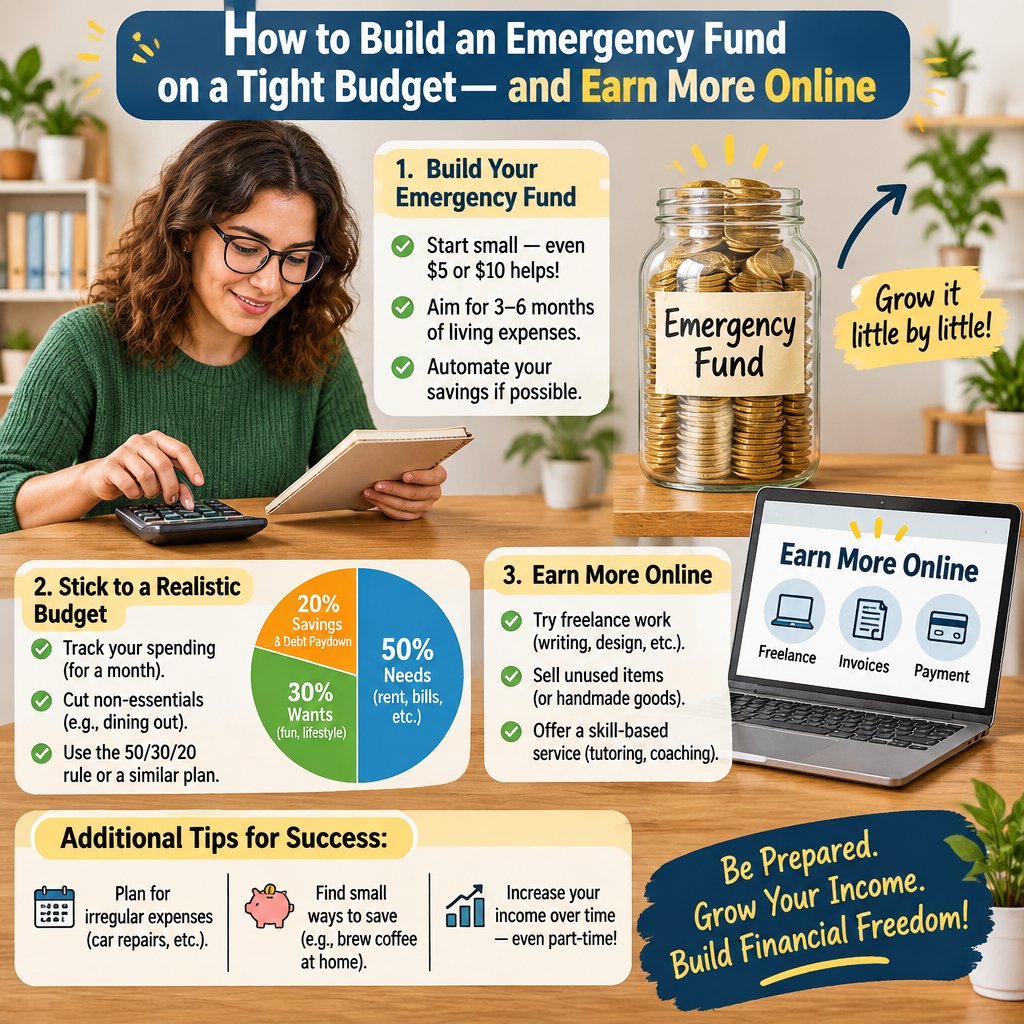
Step-by-Step: Build Savings, Then Add Income Carefully
The truth is, a workable plan beats an elaborate spreadsheet that nobody opens. Use these steps to create a simple system, then adjust it when your bills or income change.
- Choose a first target. Pick a specific amount that would help with one plausible emergency, such as an urgent repair or insurance deductible. If that target feels too large, start with $100, $250, or another reachable figure. A small first milestone is useful because it turns saving into an action rather than a distant intention.
- Track one full month of spending. Review bank and card statements, cash purchases, bills, and irregular costs. Sort expenses into broad groups: housing, utilities, food, transport, debt payments, health care, subscriptions, and discretionary spending. The Consumer Financial Protection Bureau’s budgeting resources can help you map income and expenses. Do not guess from memory; recurring charges have a habit of hiding in plain sight.
- Find changes that can last. Check large recurring expenses first. When a lease is due for renewal, ask whether rent terms are negotiable; compare internet, phone, or insurance options; and review whether refinancing a mortgage makes sense after fees and total interest are considered. There is no guarantee a provider will lower a bill, and changing a loan can cost money. A $50 monthly reduction, if it is real and sustainable, frees $600 over a year.
Smaller cuts can still help. Cancel a subscription you do not use, plan meals around food already at home, or set a weekly limit for optional purchases. Do not slash necessities, skip needed medical care, or cancel useful insurance just to make a budget appear balanced. The goal is a durable surplus, not a paper win.
- Automate an amount you can maintain. Schedule a transfer from checking to savings after payday, or ask whether your employer can split direct deposit. Start low if necessary; you can raise the amount later. Keep enough in checking for bills and avoid transfers that trigger overdraft fees. If income varies, use a small automatic base transfer and add extra after stronger earning weeks.
- Set rules for withdrawals. Define what counts as an emergency before one happens. A true urgent repair may qualify; routine maintenance should usually be planned separately. If you use the fund, write down the amount and restart contributions when the immediate problem is handled. This makes the account a tool, not an informal spending pot.
- Test one extra-income idea. Begin with skills, tools, and demand you already understand. Examples include freelance writing or design, online tutoring, virtual assistance, selling items you own, or providing a practical local service promoted online. For a digital product, first check whether people want it; the Small Business Administration’s guide to market research outlines ways to assess customers and competitors. Do not buy a costly course or inventory before testing demand.
- Calculate net earnings and set aside taxes. Record revenue, platform fees, supplies, postage, and other business costs. Gig income may have tax obligations; the IRS Gig Economy Tax Center explains relevant federal tax responsibilities. Keep business records, check local rules where relevant, and do not count every dollar of sales as spendable income. After reserving what you need for taxes and costs, transfer a chosen share to your emergency fund.
- Review the plan monthly. Compare the target with the account balance, check whether automatic transfers caused cash-flow trouble, and revise the amount if income or essential costs changed. Celebrate milestones modestly—perhaps with a free activity or a small planned treat. A reward should not erase the progress it is meant to recognize.
When I compare approaches, I favor a combination: reduce a recurring bill where possible, then use a modest side hustle to fill the remaining gap. Expense cuts can produce predictable savings, while new income has more upside but also more uncertainty. Neither replaces tracking and follow-through.
Comparison Table: Spending Cuts vs. Online Side Hustles
The two approaches solve different problems. A spending cut can release money already in the budget; an online side hustle can add revenue, but it may take time to find customers and get paid. Use the table as a planning guide, not a forecast of guaranteed earnings.
| Factor | Spending cuts | Online side hustle |
|---|
| How it helps | Reduces an existing expense and frees cash | Adds income through services, sales, or other paid work |
| Example | A sustainable $50 monthly reduction equals $600 over 12 months | $100 per month in gross sales equals $1,200 a year before costs and taxes |
| Time to start | Often quick after a bill or subscription changes | Can take time to set up, find customers, and receive payment |
| Main constraint | There may be little left to cut without harming essentials | Demand, available hours, fees, and income can vary |
| Best fit | Households with negotiable recurring costs | People with a marketable skill, item, or service and some available time |
| Main caution | A discount may expire or require a fee-bearing contract | Revenue is not profit; track costs, taxes, and unpaid work |
Let’s be real: neither column is automatically superior. If your rent, food, transport, and health costs already leave no safe cuts, more income may be the sensible lever. If you have several unused subscriptions and a serviceable phone plan, trimming costs may create savings sooner than building an audience for a new digital product.
A simple illustration helps. Saving $50 each month yields $600 over a year before interest. Earning $100 monthly through a side hustle yields $1,200 in gross annual revenue, but the spendable amount will be lower after taxes and expenses. The comparison is useful only when you compare net dollars and the hours required to earn them.
For online work, time has a cost too. A service business can produce revenue sooner than a course or affiliate site, but it usually trades hours for pay. A digital product can be sold repeatedly, yet customer research, production, updates, and promotion take effort. Calling a business passive before measuring those costs is wishful accounting.
Common Mistakes to Avoid
Most bad saving advice starts with a tidy slogan and ignores the household’s actual numbers. A plan should work on an ordinary month, not only in a perfect one.
- Waiting until you can save a large amount: A $5 or $10 transfer is not impressive, but it establishes the routine and gives you a starting balance. Increase it when you can. Do not let an ambitious target become an excuse to save nothing.
- Budgeting from memory: People often miss irregular bills, small automatic payments, and seasonal costs. Review statements and include annual or occasional expenses in the plan. A car registration bill is predictable even if it arrives once a year; save for it separately rather than treating it as an emergency.
- Cutting essentials first: Skipping medication, adequate insurance, or necessary food can create larger costs and risks. Look at optional and negotiable spending before compromising health, safety, or basic needs.
- Putting emergency money into risky investments: Stocks, crypto assets, and speculative ventures can fall in value. A fund meant for near-term emergencies needs access and stability more than the possibility of higher returns. Keep investing goals separate from emergency cash.
- Treating online income as guaranteed: A platform can change its rules, a client can disappear, and a product may not sell. Avoid paying large upfront fees for promises of effortless passive income. Verify the business, read payment terms, and start with a small test.
- Ignoring taxes and operating costs: A payment notification is not the same as net profit. Track fees, materials, travel, returns, and tax obligations. The IRS guidance is a better starting point than a stranger’s claim that gig earnings do not count.
- Using the fund for predictable purchases: Holidays, school supplies, annual premiums, and routine maintenance deserve their own sinking funds when possible. If every planned bill comes out of emergency savings, the account cannot do its intended job.
- Feeling defeated after a withdrawal: An emergency fund is meant to be used for qualifying problems. A withdrawal is not failure; the important step is to replenish it with a revised, realistic plan.
Here’s what nobody tells you: a budget is a tool for making decisions, not a test of character. If the numbers do not balance after reasonable cuts, the answer may be negotiating bills, seeking eligible assistance, increasing income, or speaking with a reputable nonprofit credit counselor—not blaming yourself or buying a miracle system.

Frequently Asked Questions
How much should I save in an emergency fund?
Start with an amount you can reach and that would cover a likely urgent expense. Then build toward one month of essential costs and revisit the target based on job stability, dependents, health needs, insurance deductibles, and access to other support. Several months of essential expenses is a common longer-term benchmark, but it is not a rule that every household can meet at once. Begin where you are.
How can I save money when my budget is already tight?
Track actual spending, check recurring bills for negotiable costs, and use a small automatic transfer only if it will not cause an overdraft. If there is no safe expense to cut, look for ways to increase income or access trustworthy community and public resources. A small amount saved regularly can still create a useful buffer. Do not skip essential care to hit a target.
What is a realistic way to make extra money online?
Start with a service or item people already pay for, such as tutoring, editing, design, virtual assistance, or resale of goods you own. Test demand before spending heavily on software, inventory, or training. Estimate fees, taxes, time, and payment delays before deciding how much can go to savings. No legitimate option guarantees easy or immediate income.
Is passive income a good way to fund emergency savings?
It can contribute, but most so-called passive income requires money, skill, or work upfront and may remain uncertain. Interest from a deposit account is relatively simple but depends on the account’s rate and balance; a digital product or affiliate business needs customers and upkeep. Do not invest money you may need soon in a risky scheme. Build liquid emergency savings first.
Final Thought
Start with a small target and a clear rule for adding to it. Track spending for a month, make one or two changes that do not undermine essentials, and automate a transfer that your cash flow can support. If that still leaves too little, test one legitimate way to earn more and judge it by net income—not glossy sales claims.
The right plan is not the one with the most impressive spreadsheet or the biggest promised return. It is the one you can maintain while paying real bills, caring for people who depend on you, and adapting when circumstances change. An emergency fund will not prevent every hardship, but even a modest reserve can give you more choices when a surprise arrives.
Keep the money accessible, keep your expectations grounded, and review the plan as life changes. If you need to use the fund, use it for the reason you saved it, then rebuild at a pace that fits your current means. Consistent, honest work and careful stewardship may look ordinary. That is precisely why they tend to outlast flashy shortcuts.