How to Make Money Online: Side Hustles, Passive Income, and a Business That Fits Your Life
A side hustle is paid work you do outside your primary job, whether that means freelance writing, delivery driving, selling items online, or building a small digital business. The right choice depends less on hype than on your available hours, useful skills, startup costs, and the reason you want extra income in the first place.
People choose side gigs for different reasons. Some want to pay down debt or save for a major expense; others want a financial cushion or a way to use skills that their main job does not call for. The Penny Hoarder’s March 2026 Side Hustle survey reports that 62% of respondents with side gigs treat them as job-loss insurance. That is a useful signal of why people seek extra income, not a promise that every gig will provide dependable protection.
You do not need a grand business plan to begin. You do need an honest estimate of your time, costs, and likely return—and a willingness to stop or adjust an idea that is not working. Frankly, that is more useful than another promise of easy money.
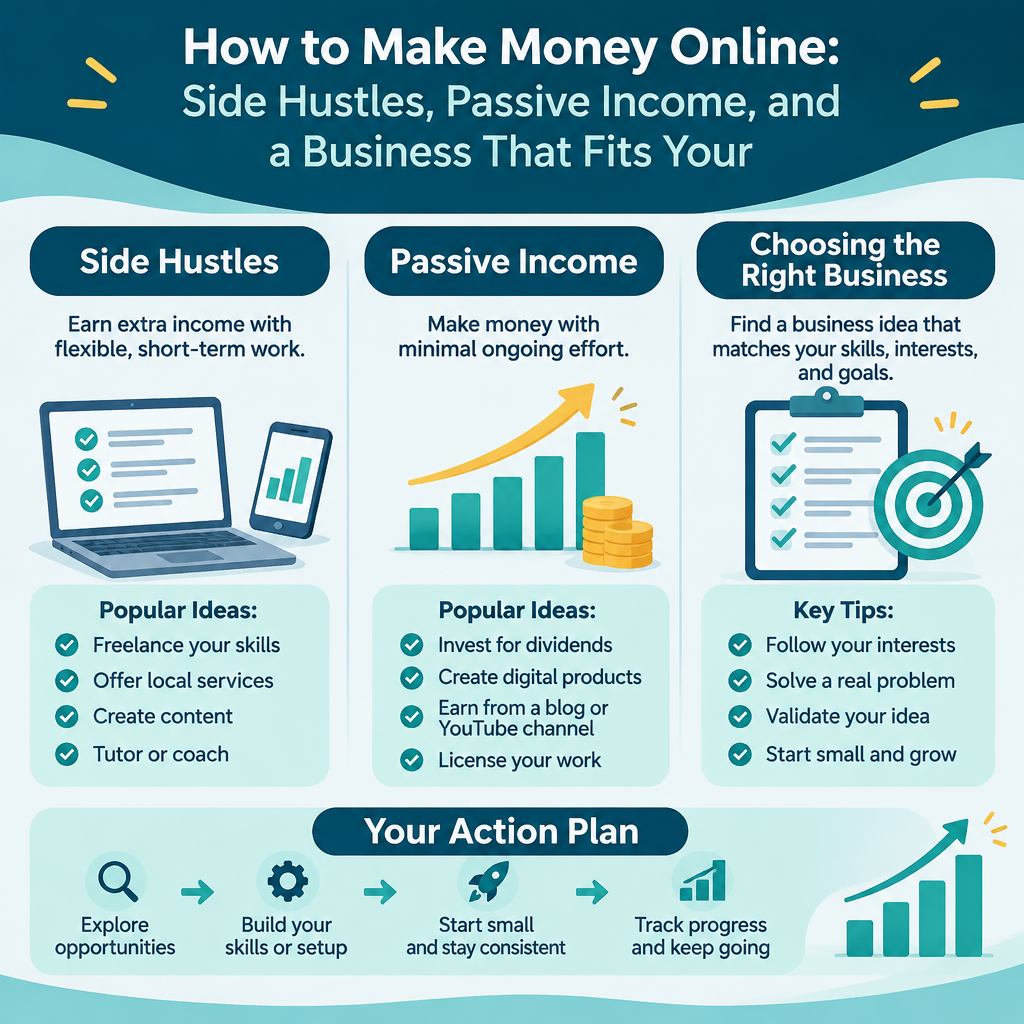
What Is a Side Hustle?
A side hustle, also called a side gig, is paid work you do outside your primary job. It may be a one-time project, recurring freelance work, a local service, or a small business you operate in your spare time. Online options include writing, design, tutoring, virtual assistance, selling products, and creating educational material; offline options include delivery, rideshare driving, pet care, and event work.
The label describes when and why you work, not how the income is produced. A delivery shift pays for time and completed jobs. A freelance project pays for a defined skill or result. An online shop may earn money from each sale, while a digital product can be sold repeatedly after you create it. Those distinctions matter because time demands, expenses, customer service, and the chance of repeat revenue vary widely.
Passive income is often used to describe money earned without doing the same amount of work for every sale. It rarely means no work. A course needs useful content, a shop needs customer support and updates, and an investment carries risk and may need capital. Automation can handle repeatable tasks such as sending a receipt or delivering a download, but it cannot make an untested offer valuable. Treat passive income as a business model to investigate, not a shortcut with guaranteed results.
A side hustle can also test a business idea before you depend on it. For example, a bookkeeper might offer a few paid consultations, learn which clients need help, and refine the service before considering a larger operation. That small experiment can reveal whether customers will pay, how long the work takes, and whether the schedule is sustainable. When I assess an idea, I separate evidence of demand from enthusiasm for the idea itself. They are not the same thing.
Core Benefits and Importance
Extra income is the obvious benefit. A few paid projects may help cover a bill, build savings, reduce debt, or pay for an expense without changing your primary employment. The amount left over matters more than the gross amount advertised: transport, supplies, platform fees, equipment, and taxes can take a bite out of earnings. Track those costs from the first job.
A side gig can also spread risk. The Penny Hoarder survey’s finding that 62% of respondents use side gigs as job-loss insurance suggests that some people value income beyond their main paycheck. Still, a gig is not automatically a safety net. Customer demand can fall, a platform can change its terms, and irregular work may not replace a stable salary or benefits. Think of it as one part of a financial plan, not a substitute for one.
There is a skills benefit, too. A person who sells a service learns to scope work, set prices, communicate with customers, and manage deadlines. Those skills can carry into a current job or a future business. A small project can also show whether you enjoy the day-to-day work—not just the idea of being your own boss.
Some side hustles can grow. A freelancer may build repeat clients; a seller may find a product with steady demand; a creator may develop a paid resource. Growth depends on a workable offer, a way to reach customers, and sound unit economics. Scalability means revenue can increase without every new sale requiring an equal increase in your labor, but it usually requires upfront effort, reliable systems, or investment.
There is a personal benefit when the work uses abilities that sit idle in your main role. That does not mean every passion should be monetized. Protect time for rest and family, and choose work that treats customers fairly. Good stewardship includes using resources responsibly; it also includes recognizing that attention and energy are resources. Here's the kicker: the most profitable-looking option may be a poor fit if it leaves you exhausted or creates costs you did not count.
Step-by-Step Guide to Choosing and Starting
- Set one clear goal. Decide what the extra income is for and what success would look like. A specific target—such as earning enough to cover a recurring bill or testing whether customers will pay for a service—is easier to assess than a vague desire to make more money. Set a time limit for your first test, too. You can review the results after a month or a few completed projects instead of drifting into a commitment that no longer serves you.
- Take inventory of time, skills, and resources. Write down the hours you can reliably offer, the skills people already ask you to use, and any equipment or funds you can afford to risk. Include commute time, childcare, family responsibilities, and recovery time. A gig that appears to require five hours may take eight once preparation and travel are counted. Be honest about the budget: do not borrow heavily or buy expensive equipment before you have evidence of demand.
- Choose a work model that fits the goal. If you need near-term cash, a local service, short freelance project, or sale of unused items may be more direct than building an audience. If you want to develop a digital business, consider a service, an online store, or a downloadable product—but account for the time spent finding customers. If your aim is income with less repeated labor, look at assets or systems that can serve more than one buyer. Each route has trade-offs; none is effortless by definition.
- Check whether buyers exist. Ask potential customers what they currently do, what problem remains, and what they have paid for similar help. Search for comparable offers and read customer questions and reviews. The U.S. Small Business Administration recommends researching customers and competitors before launching; its guide to market research and competitive analysis is a sensible starting point. Do not mistake likes, compliments, or a friend’s encouragement for proof that strangers will pay.
- Estimate the real return. List startup costs and recurring expenses, including platform charges, materials, payment processing, insurance where relevant, and taxes. Then estimate time spent on sales, preparation, delivery, revisions, and administration. Compare the money left after expenses with the total hours worked. This is a rough ROI check, not a forecast guaranteed to hold. If the numbers look weak, change the price, reduce costs, narrow the offer, or choose another idea before investing more.
- Run a small test. Offer a limited number of paid jobs, make a small batch, or publish one useful resource before building a large catalog. Write down what customers asked, what took longest, and whether they returned or referred someone. Set expectations in writing: what is included, when it will be delivered, how revisions work, and what happens if plans change. A modest paid test teaches more than weeks spent polishing a logo that no customer has seen.
- Build simple systems once the work repeats. Use templates for common messages, scheduling tools for bookings, and clear records for income and costs. Automation can save time on repetitive administration, but keep a human eye on customer questions, quality, and refunds. Do not automate a process you have not checked manually; that simply spreads mistakes faster. Protect customer information and use reputable payment and storage services.
- Handle tax and legal duties. Income from gig work may have tax obligations even when it is part-time or paid through an app. The IRS Gig Economy Tax Center explains federal tax considerations for people earning through platforms and other gig arrangements. Keep records, set aside money as appropriate, and check rules that apply where you live. Requirements vary by work type and location, so seek qualified advice if the situation is complicated.
- Review and decide. At the end of your test, compare actual earnings, hours, expenses, customer response, and stress with your original goal. Continue if the results justify the effort, adjust one part if the idea has promise, or stop if the numbers and schedule do not work. I favor a short review cycle because it puts evidence ahead of sunk costs. A side hustle is optional; you do not owe an idea endless weekends.

Side Hustle vs. Primary Job
A side hustle and a primary job can both produce income, but they serve different roles. The main job may provide a predictable schedule, regular pay, workplace benefits, and established responsibilities. A side gig usually offers more choice about the work, but that flexibility can come with irregular demand, unpaid administrative time, and out-of-pocket costs. The comparison is not a contest with a universal winner; it is a way to see what each option can and cannot do for you.
| Factor | Side hustle | Primary job |
|---|
| Main purpose | Extra income, skill use, or a business test | Core earnings and, sometimes, benefits |
| Schedule | Often chosen or negotiated, but customer demand may dictate hours | Usually set by an employer or contract |
| Income pattern | Can be irregular and depends on work, customers, or sales | Often more predictable, though not guaranteed |
| Startup costs | May require tools, supplies, fees, or marketing | Often limited for the worker, depending on the role |
| Growth potential | Can develop into repeat clients or a scalable offer | May grow through raises, promotion, or role changes |
| Administrative load | Worker may handle sales, records, and taxes | Employer generally handles more payroll administration |
| Best use | A defined goal or a measured experiment | Stable core income and career development |
For many people, the sensible choice is both: keep a primary job while testing a side gig at a manageable scale. Do not assume a promising month proves that a new business can replace regular income. Consider repeat customers, seasonality, taxes, benefits you might lose, and the time required to find new work. The SBA’s guide to writing a business plan can help organize costs, customers, and next steps if the test becomes a real business. Frankly, a spreadsheet with honest assumptions beats a dramatic resignation speech.
Common Mistakes to Avoid
Believing that passive means effortless. Digital products, affiliate content, online shops, and automated services still need research, creation, promotion, maintenance, and support. A product can sell repeatedly, but repeated sales depend on usefulness and customer access. Ask what work happens before launch and what continues afterward. If someone promises easy, reliable money without explaining the costs or risks, keep your wallet shut.
Choosing an idea because it is popular. A trend may have plenty of competition and little room for a new seller. Choose work where your abilities and access to customers give you a reasonable starting point. The best fit might be a plain local service rather than the newest online scheme. Check what people actually buy, not only what creators claim they earn.
Ignoring expenses and unpaid hours. Gross revenue is not take-home income. Count materials, mileage, platform charges, refunds, advertising, preparation, bookkeeping, and customer messages. A gig can look lucrative until every hour is included. Set a minimum acceptable return for your time and review it after a few paid jobs.
Buying too much before testing demand. Expensive courses, software, inventory, and branding can consume money before a single customer appears. Start with the smallest credible test. Borrow, rent, or use tools you already have where that is safe and practical. Spend more only when the evidence supports it.
Mixing business and personal records. Disorganized transactions make it harder to see whether the work earns a profit and can complicate tax filing. Keep receipts and a clear record of payments and expenses. The IRS guidance linked above is a starting point, not a substitute for advice about your exact circumstances.
Treating every platform as dependable. A marketplace or social network can change fees, rules, visibility, or access. Keep copies of your work and customer records where lawful, follow platform terms, and build more than one way to reach buyers when possible. If you promote products for payment or commission, disclose relationships clearly; the FTC’s disclosure guidance for social media influencers explains basic expectations for endorsements.
Letting the side gig consume the life it was meant to support. A side hustle should serve a goal, not quietly take every evening. Set working hours and a stop point. If sleep, health, family duties, or your primary job are suffering, cut the workload or reconsider the model. Let's be real: extra income loses its shine when the hidden bill is constant exhaustion.
Frequently Asked Questions
What is the easiest side hustle to start?
There is no single easiest option for everyone. Selling unused items may require little setup if you already own things buyers want; a service based on an existing skill can also be quick to test. Delivery or local task work may be accessible in some places, though eligibility, demand, expenses, and platform rules vary. Compare the setup burden with the amount you keep after costs. Start with work you understand, and avoid paying a large fee for access to a supposed opportunity.
Can a side hustle become passive income?
Some side businesses can earn revenue without repeating every task for each sale, but they are not automatically passive. A downloadable guide, recorded class, or online product takes time to make and still needs marketing, updates, customer support, and payment administration. Automation may reduce repeated work once a process is reliable. Treat any income estimate as uncertain, and test whether buyers want the offer before building a large system around it.
How much money can I make from a side hustle?
Income depends on the work, hours, skill level, customer demand, location, pricing, and expenses. Some gigs provide occasional extra cash; others may develop into a substantial business over time. There is no sound universal figure that applies to every person or category. Track net income and total hours rather than relying on a headline revenue claim. A useful first target is a modest, measurable result tied to your own budget and schedule.
Do I have to pay taxes on side hustle income?
A side gig can create tax responsibilities, even when it is not your main job or the payment comes through an online platform. The specific rules depend on your situation and location. Keep records of income and related expenses, and review the IRS Gig Economy Tax Center for federal guidance. If you are unsure how the rules apply, consult a qualified tax professional rather than guessing.
A side hustle is a tool, not a verdict on your ambition. It can help build savings, pay for a large expense, put unused skills to work, or test a business idea while your main income remains in place. The practical question is not whether an idea sounds exciting; it is whether real customers will pay enough to justify the time, risk, and care it requires.
Start with a small commitment and clear records. Respect the people buying from you, price the work honestly, and protect the hours you need for the rest of life. If the numbers improve and the work suits you, build carefully—one repeatable step at a time. If they do not, stopping is not failure; it is useful information gathered before the cost grew. A good side hustle earns money, certainly, but it should also leave you with a clearer view of what your effort is worth.