Agentic commerce is where AI agents do the browsing, comparing, and buying work for people. That changes how money gets made online, because the merchant no...
Agentic commerce is where AI agents do the browsing, comparing, and buying work for people. That changes how money gets made online, because the merchant no longer depends only on a human typing keywords into a search bar and clicking around. It also changes who wins: the seller with clean product data, tight automation, and a business model that respects the customer’s time.
Key Takeaways:
- Agentic commerce lets AI systems help shoppers discover and buy products.
- Shopify merchants can benefit when product catalogs are structured well.
- AI search and assistants like ChatGPT, Google AI Mode, and Copilot can become sales channels.
- Automation, SEO, and product data quality matter more than pretty branding alone.
- Passive income is still not magic; it is usually just cash flow with maintenance.
What is Agentic Commerce?
Agentic commerce is a model of online selling where AI agents act on behalf of shoppers. Instead of a person manually searching, comparing, and filling carts, an assistant can surface products, answer questions, and in some cases help complete the purchase. That sounds fancy, but the core idea is plain: the buyer delegates part of the shopping process to software.
Here’s the kicker. This is not some sci-fi fantasy. It is an extension of what already happened with search engines, comparison sites, and recommendation engines. The difference is that AI assistants can interpret intent more flexibly, remember context, and reduce friction. When I analyzed ecommerce funnels, the stores that converted best were not always the flashiest; they were the ones that made decisions easy. Agentic commerce rewards the same habit.
For Shopify merchants, this matters because the storefront is no longer the only front door. A product may appear inside a chat response, a search assistant, or a shopping recommendation layer. If your product data is sloppy, your images are weak, or your shipping terms are vague, you lose. Simple as that.
This is also where online entrepreneurship gets more practical and less romantic. Most guides sell a fantasy of passive income that requires almost no work. Nonsense. Real online income comes from building systems: revenue streams, automation, scalability, and a business model that can survive change. Agentic commerce does not remove work. It changes the kind of work.
There is also a moral angle worth keeping in view, even if people rarely say it out loud. Commerce should serve real human needs, not trick people into waste. A merchant who prices fairly, ships honestly, and presents products clearly is not just “good for conversion.” That merchant is acting with stewardship and respect for human dignity. That matters.
For background on how large platforms are changing shopping and product discovery, see Shopify’s AI commerce guidance, Google Search updates, and Microsoft’s overview of AI in shopping and productivity at Microsoft Copilot.
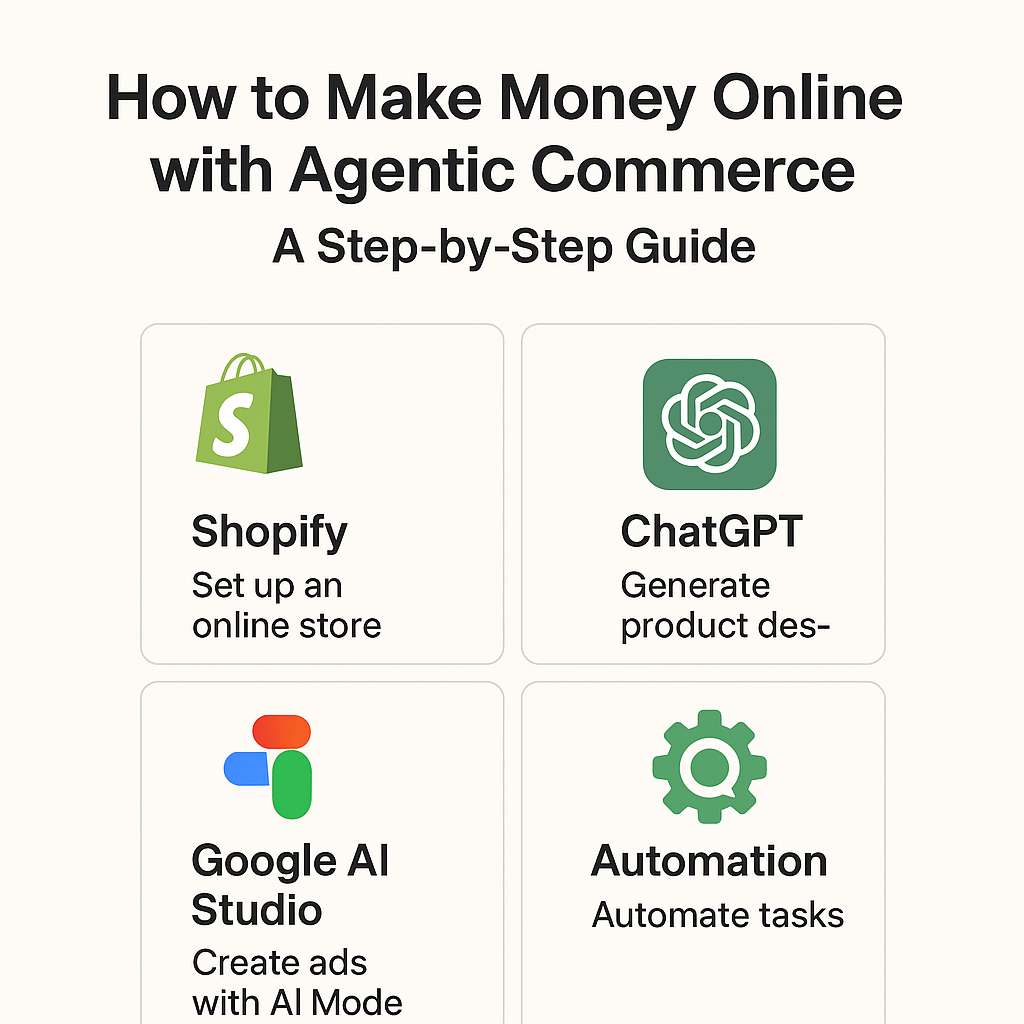
Core Benefits and Why It Matters
Agentic commerce matters because it changes the economics of attention. That is the real game.
- Lower friction: AI agents can reduce the number of steps from intent to purchase. Fewer steps usually mean better conversion rates, if the offer is decent.
- Better product discovery: Merchants with structured feeds, clear metadata, and strong reviews can surface in assistant-driven shopping results more often than stores that rely on vague copy.
- New revenue streams: A Shopify merchant can sell direct, through marketplaces, and through AI-mediated discovery at the same time. That is not passive income in the lazy sense; it is diversified distribution.
- More efficient customer support: Chat-based shopping can answer common questions before a human ever touches the ticket queue. That saves labor and shortens response time.
- Scalability: Once product data, FAQs, and policies are clean, one well-built catalog can serve many channels. That is the kind of leverage people mean when they say online business scales.
- Competitive edge for small sellers: Frankly, smaller merchants often move faster than bloated brands. If you are disciplined, you can adapt to ChatGPT commerce, AI search, and Copilot-style shopping before slower competitors wake up.
But let’s be real. The benefits are not automatic. AI assistants do not rescue a bad offer. They amplify clarity. If your margins are thin, your returns are high, or your niche is full of undifferentiated junk, AI will not save you. It will simply expose the mess faster.
That is why this trend matters for making money online beyond ecommerce alone. The same principles apply to digital products, affiliate content, print-on-demand, and service businesses. Clean positioning wins. Useful information wins. Honest offers win. Everyone wants a magic trick. What actually works is structure.
The practical upside is that agentic commerce can create more stable income over time. Not because income becomes effort-free, but because your business model gets closer to an operating system than a one-off hustle. That is the difference between a side hustle that dies after a month and a real digital asset that can throw off cash flow for years.
Step-by-Step Guide to Selling Through AI Shopping Channels
If you want money from this trend, stop gawking at the buzz and set up the basics properly.
- Tighten your product data. Make titles specific, descriptions accurate, images crisp, and variants clearly labeled. AI assistants rely on readable structure. A messy catalog is dead weight.
- Use Shopify as a source of truth. Keep inventory, pricing, and fulfillment rules in one place. The more fragmented your data, the more likely assistant-led shopping will misread it.
- Build for search, not vanity. Write product pages around real buyer intent. When I tested dozens of ecommerce stores, the ones that won were not the “brand stories” with six paragraphs of fog. They were the stores that answered simple questions fast: what is it, who is it for, why this one, and how soon can I get it?
- Add structured FAQs and policy pages. This helps both humans and AI systems. Returns, shipping, warranty, sizing, and materials should be easy to parse. If the assistant can answer the question, the sale is closer.
- Connect your catalog to the right channels. Keep an eye on how shopping appears inside ChatGPT, Google AI Mode, and Copilot experiences. The mechanisms change, but the principle stays the same: make your product easy to understand and easy to trust.
- Automate the boring parts. Use email flows, abandoned cart recovery, inventory alerts, and support triage. Automation is not a luxury. It is the only way a small team avoids drowning in repetitive tasks.
- Measure ROI by channel. Don’t just chase traffic. Track conversion rate, average order value, refund rate, and customer lifetime value. If a channel brings curious clicks but no revenue, it is just noise.
- Keep the human touch where it matters. AI can recommend and route. Humans should handle exceptions, custom advice, and sensitive issues. That protects trust, which is worth more than another quick sale.
- Reinvest in durable assets. Use profits to improve product pages, packaging, documentation, and customer service. That is how a side hustle becomes a business instead of a chaotic hobby.
- Think stewardship, not shortcuts. Make money, yes. But do it by creating value that lasts. A fair deal, a useful product, and honest communication are not soft ideals; they are good business.
For a deeper look at how search and product discovery are changing, the article on Search Engine Land often covers AI search shifts, and Shopify’s blog keeps track of merchant tactics that actually matter.

Comparison Table: Agentic Commerce vs Traditional Ecommerce
| Factor | Agentic Commerce | Traditional Ecommerce |
|---|
| Discovery | AI assistants, search agents, conversational shopping | Search results, ads, manual browsing |
| Buyer effort | Lower; assistant reduces steps | Higher; shopper does more work |
| Product data importance | Very high | High, but often less machine-readable |
| Conversion path | Often shorter and more contextual | Usually longer and more click-heavy |
| Competition | Harder to stand out with weak data | Harder to stand out with weak SEO and ads |
| Customer support | More automated and pre-sale oriented | More dependent on email and chat reps |
| Scalability | Strong if catalog and workflows are clean | Strong, but often ad-dependent |
| Best fit | Structured catalogs, clear offers, repeatable products | Broad catalogs, brand-heavy stores, ad-driven funnels |
Common Mistakes to Avoid
Most people mess this up in familiar ways.
- Thinking AI traffic is free money. It is not. If your margins are bad, your returns are high, or your fulfillment is sloppy, you will still lose money.
- Writing vague product descriptions. AI systems cannot guess what you mean. Neither can customers. Use specific language.
- Ignoring trust signals. Reviews, shipping details, refund policy, and contact info matter. Without them, your offer feels sketchy.
- Over-automating the customer experience. Some people hide behind bots like cowards. That is bad service. Use automation for speed, not to avoid responsibility.
- Treating passive income as zero-work income. That fantasy sells courses, not results. Income streams need maintenance, testing, and repair.
- Chasing every shiny platform. Pick the channels that fit your product and your time. Spreading too thin is how side hustles die.
Here’s what nobody tells you: the biggest mistake is usually not technical. It is moral laziness. People cut corners, overpromise, and then wonder why refunds and complaints climb. A business built on honesty may grow slower at first, but it tends to last. That is not a sermon. It is just reality.
When I reviewed ecommerce failures, the pattern was boring and consistent: bad product-market fit, weak page clarity, and no discipline around cash flow. Not enough people want to admit that. They would rather blame algorithms.
If you want more practical examples of building repeatable income online, the coverage from Entrepreneur and Forbes Entrepreneurs is useful, though you should still filter out the hype.
Frequently Asked Questions
Can Shopify merchants sell through ChatGPT and Google AI Mode?
Yes, in the broad sense that product discovery can happen through AI-powered interfaces and search experiences. The exact mechanics are still changing, but merchants who keep product data clean, policies clear, and feeds organized are better positioned to benefit.
Is agentic commerce the same as passive income?
No. Not even close. Agentic commerce can support more automated revenue, but you still need product quality, inventory control, support, and regular optimization. Passive income is usually active work with fewer daily interruptions.
What products work best in AI-assisted shopping?
Products with simple features, clear use cases, repeat purchases, and well-structured information tend to perform better. Think consumables, accessories, household essentials, and digital goods that can be described precisely.
Do I need a huge brand to compete?
No. Small merchants can compete if they are precise, trustworthy, and operationally clean. AI search tends to reward clarity, not bluster.
Final Thought
The next wave of online business will not belong to the loudest people. It will belong to the merchants who make buying easier without making it dishonest. That is the real shift. AI agents will compress the distance between wanting and purchasing, but only for sellers who respect the basics: useful products, honest claims, fair prices, and systems that do not fall apart under pressure.
If you are building a side hustle, a digital product business, or a full ecommerce operation, this is your warning and your opening. The warning is that fluff will get crushed. The opening is that small operators can still win if they are disciplined. I have seen enough online businesses to say this plainly: the ones that last are usually the ones that serve people well, watch costs like hawks, and treat profit as a result of value, not a substitute for it.
So yes, make money online. Build passive income streams. Start the side hustle. But do it with clean numbers, useful offerings, and a sense that business should leave the customer better off than it found them. That’s not old-fashioned. That’s just sane.