Pricing an online course is the process of setting a fee that reflects the outcome, support, and convenience students receive while covering the costs of...
How to Price an Online Course: Models, Strategy, and Practical Steps
Pricing an online course is the process of setting a fee that reflects the outcome, support, and convenience students receive while covering the costs of running the business. A sound price is neither a guess nor a verdict on your worth; it is a testable business decision built around value, audience, and evidence.
Key Takeaways- Price the outcome and learning experience, not just the hours spent recording lessons.
- Check audience needs, competing offers, delivery costs, and the support your course includes.
- Pick a payment model that fits the product: one-time, installment, subscription, tiered, or bundled.
- Test prices with real customers, and use honest discounts rather than invented reference prices.
- A course does not need to suit everyone. It does need to deliver what its sales page promises.
A low price can feel safer when selling makes you uncomfortable, but cheap does not automatically mean accessible, and expensive does not automatically mean valuable. The right number depends on the student’s problem, the course’s usefulness, the alternatives available, and whether the business can keep delivering a good experience at that price. Frankly, guessing once and refusing to revisit the number is not a strategy.
Course creators often confuse the price with a personal judgment. A student is not buying your self-esteem or paying back every late night spent editing video; they are deciding whether a clear result, a useful structure, and any included support justify the fee. That distinction makes pricing less emotional and more practical. Start with evidence, explain the offer plainly, then improve it as you learn.
What Is Online Course Pricing?
Online course pricing is the method a creator uses to set the amount and payment terms students exchange for instruction, resources, community, and support. It includes more than the headline price. A one-time fee, a monthly membership, a payment plan, and a course-plus-coaching package can all produce different customer expectations and different revenue patterns. The price is part of the business model, not a decorative number on a checkout page.
A useful price accounts for the value a learner hopes to receive, the work required to create and maintain the offer, the cost of serving each student, and the audience’s ability and willingness to pay. Those pieces do not produce one mathematically perfect answer. They give you a defensible range to test. The U.S. Small Business Administration’s guide to market research and competitive analysis is a practical starting point for learning what customers need and how alternatives are positioned.
Value-based pricing is often misunderstood. It does not mean charging the largest amount a hopeful buyer might tolerate, nor does it mean claiming that a course will transform a life. It means considering the useful result, the time or confusion the course may save, the quality of instruction, and the actual level of support. A student can find free videos online, but a well-designed course may organize scattered material into a sequence, provide practice, and help learners avoid common dead ends. That convenience can have value; it is not a license to make inflated promises.
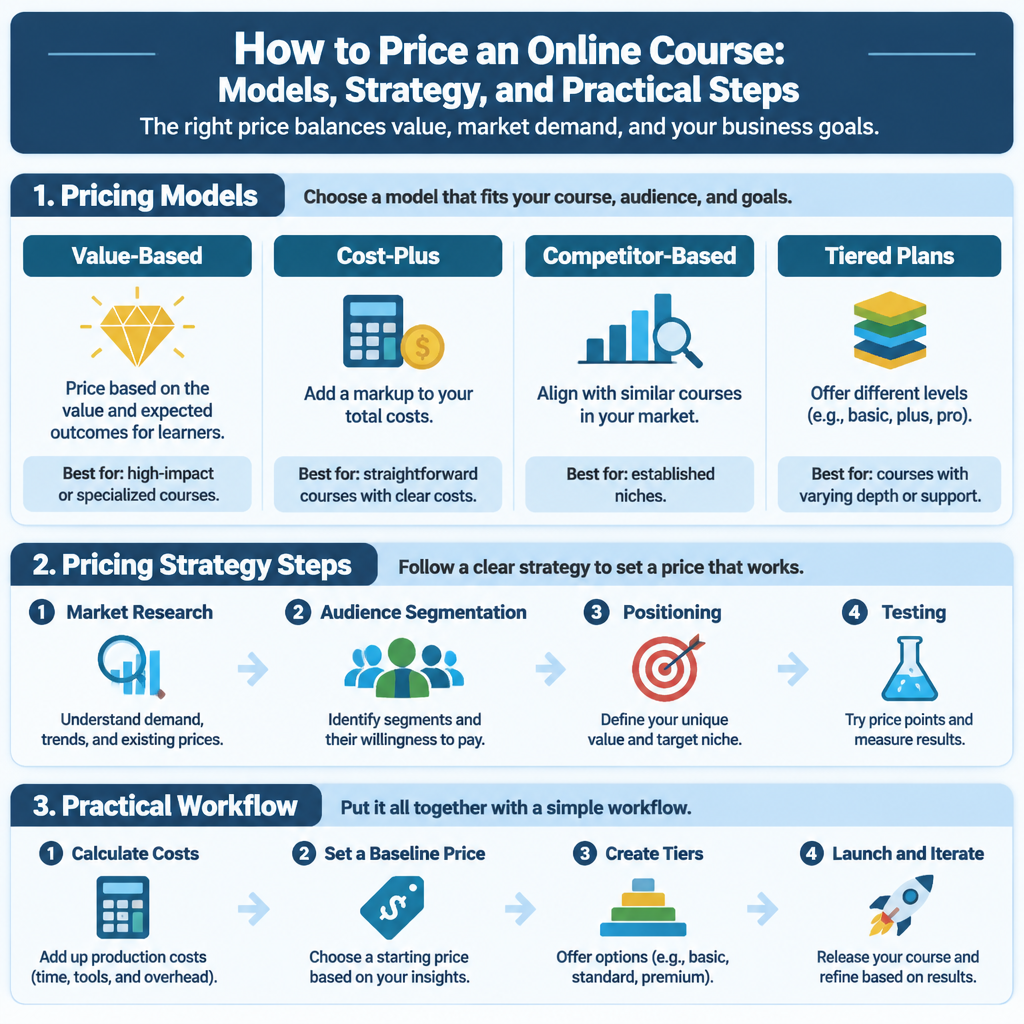
I assess course offers by separating three questions: What change does the course help a student work toward? What evidence supports the promise? What does delivery cost the business? A creator who can answer all three has a stronger basis for setting a price than someone who copies a competitor or divides editing hours by projected sales. The second calculation is especially flimsy because it assumes the number of sales before the market has answered.
Keep personal worth out of the arithmetic. Expertise can come from professional practice, research, teaching, or a clearly defined experience, but it should be represented honestly. A beginner-level course should say that it is beginner-level; a course without individual feedback should not imply hands-on coaching. Treat the learner’s time and money as resources entrusted to you. Clear claims and fair delivery respect the dignity of both teacher and student, which is better business than hype.
Why Course Pricing Matters
Price affects who considers an offer, how the offer is understood, and whether the business can serve students well after checkout. It also shapes revenue, cash flow, and the resources available for updates. Here’s the kicker: a price that produces more enrollments can still be a poor choice if each sale leaves too little to support the promised service.
- It signals the scope of the offer. A self-paced set of lessons is not the same product as a course with instructor feedback, live sessions, or private coaching. The price should make sense beside the actual experience. A high fee cannot manufacture credibility, and a very low fee may leave a student wondering whether essential support is missing.
- It supports sustainability. Revenue must cover platform fees, payment processing, software, customer service, refunds, taxes, and the creator’s compensation. If the numbers do not work, the likely outcome is neglected updates or hurried support. A business that pays its bills can keep its commitments.
- It influences access. Payment plans, scholarships, or a lower-cost self-study tier may help different students participate without pretending every learner has the same budget. These options should be designed carefully: an installment plan changes when money arrives and adds collection risk, while extra support costs real time.
- It helps distinguish products. A basic course, a group-coaching package, and a one-to-one program can serve different needs. Thoughtful tiers let students choose the amount of guidance they want. The offer must explain the differences rather than dressing up the same material with a higher price tag.
- It provides a way to learn. Conversion rates, refund requests, sales conversations, and completion patterns can reveal whether the promise, curriculum, support, or price needs work. None of these signals proves the price alone is wrong. Look for a pattern instead of reacting to one quiet week.
There is a contrarian point worth keeping: lowering the price is not always the kindest move. A low price paired with poor support can waste a learner’s money and your capacity. Conversely, a premium price can be reasonable when the course offers meaningful expertise and responsive guidance, but it creates a greater duty to describe those benefits accurately. Price should follow the offer, not cover for a weak one.
Think in terms of revenue streams, ROI, and scalability, but do not let those terms obscure the ordinary work. A course can serve many students without adding an hour of private instruction for each one, while coaching depends directly on available time. That difference matters. Put a capacity limit on coaching when needed, and do not sell more direct access than you can provide.
Step-by-Step: How to Set Your Course Price
- Define the result and the buyer. Describe one specific learner and the problem they want to solve. A broad promise such as learn marketing is hard to price because it says little about who needs the course or what they will be able to do. A more concrete promise identifies the skill, starting point, and limits. Talk with prospective learners, read support questions, and review the language customers use. The SBA’s market-research guidance can help structure that investigation. Do not assume interest from likes or compliments equals willingness to pay. Ask about past attempts, obstacles, and what a useful solution would include.
- Map the full offer. List lessons, templates, assessments, office hours, community access, and coaching sessions. Separate what every student gets from optional add-ons. Then describe the expected work: how much time the student needs, what prerequisites apply, and when access ends, if it does. A detailed offer helps prevent a common mismatch in which the sales page suggests personal help but the product is entirely self-serve. When I assess a course, I look for this gap before I look at the price. Buyers need to know what they are actually purchasing.
- Research alternatives without copying them. Review competing courses, books, free video channels, workshops, and one-to-one services that address the same problem. Compare audience, depth, format, instructor access, and stated outcomes. A competitor’s price is a clue, not a command; the course may have a larger brand, a different scope, or a different cost structure. Use the SBA market research guide to think about customers and competitors systematically. Note what your offer does better and where it does not. If your only distinction is a cheaper price, the business will have little room to improve the product.
- Work out the financial floor. Add fixed business costs, variable costs per student, a reasonable amount for your labor, and a reserve for updates or unexpected expenses. Estimate a realistic number of enrollments rather than the number you hope to sell. A simple break-even calculation is fixed costs divided by contribution margin per sale; contribution margin is the price minus costs that rise with each enrollment. The result is a planning aid, not a promise. Include payment processing, refunds, taxes, and support time where relevant, and consult a qualified tax or accounting professional for situation-specific advice. A payment plan may improve affordability but changes cash flow and can add failed-payment work.
- Choose the payment model. A one-time payment is easy to explain and suits a course that offers a defined body of material without ongoing additions. Installments divide a larger total into smaller payments; show the total cost and payment schedule clearly. A subscription or membership fits recurring content, community, or regular instruction, but it brings an ongoing duty to deliver and retain members. Tiered pricing can separate self-paced learning from group or private support. Bundles combine products such as a course, workbook, and coaching session. Start with the simplest model that supports the product. Stripe’s overview of pricing strategies discusses the trade-offs involved in structuring prices; the right choice still depends on your audience and delivery costs.
- Test, then adjust with care. A small paid pilot can show whether students understand the offer, finish the lessons, and value the support. Set a clear pilot price and explain what is included. Ask for feedback, monitor refunds and questions, and fix product problems before concluding the number is wrong. You can test a new price with a later cohort, but change one major factor at a time when possible. A price increase is easier to explain when the course has gained lessons, stronger resources, or more support. Keep a record of what changed and when; memory tends to give business owners a rather flattering account of what worked.
For coaching packages, calculate capacity as carefully as revenue. Estimate the hours spent preparing, meeting, responding between sessions, and following up. Then decide how many clients you can support without reducing quality or crowding out course development. A course can scale more readily than individual coaching, but it still needs customer service, platform upkeep, and occasional revision. Do not sell unlimited access unless you have defined what unlimited means and can meet that promise.

Comparison: Paid Online Courses vs. Free DIY Learning
The most direct competitor for many courses is free content: videos, blog posts, podcasts, and public tutorials. Free resources can be excellent, and a paid course should not pretend otherwise. The meaningful comparison is usually not whether the facts exist elsewhere; it is whether the course saves effort, adds structure, provides practice, or includes support that matters to this learner. Let’s be real: some people should use free resources, and that is fine.
| Factor | Paid online course | Free DIY content |
|---|
| Upfront price | Set fee, subscription, or installments | Usually no direct purchase fee |
| Structure | Planned sequence, lessons, and checkpoints | Learner assembles materials and order |
| Support | May include instructor, peers, or feedback | Often limited or dependent on public comments |
| Convenience | Curated path can reduce searching | Requires time to find and assess material |
| Best fit | Learners who value guidance, structure, or a defined program | Self-directed learners with time to compare sources |
| Main risk | Paying for a weak course or vague promise | Losing time to scattered or outdated information |
A paid course earns its fee only when its design creates a real advantage for the intended student. That could mean a coherent sequence, practice tasks, feedback, trustworthy references, or a focused explanation that removes avoidable confusion. It does not automatically mean guaranteed results. Skills, circumstances, effort, and outside conditions affect what a student achieves, so use language that describes the course’s role without promising an outcome you cannot control.
The business comparison matters too. Free content can attract attention and build trust, while a paid course can provide a more complete learning product. A sensible sales page explains the distinction without insulting free resources or shaming people who do not buy. The U.S. Federal Trade Commission’s advertising guidance for small businesses is a useful reminder that promotional claims should be truthful and supportable. Show the syllabus, sample lesson, format, and limits. Let people decide with the facts in front of them.
Common Course Pricing Mistakes to Avoid
Pricing from discomfort. Creators sometimes choose a low figure because asking for money feels awkward, then call it accessibility. That may hide a fear of rejection rather than a thoughtful decision about students. Separate the discomfort from the offer: write down the learner’s result, the delivery cost, and the evidence for the price. A lower price can be right, but it should be chosen for a reason. Do not turn self-doubt into the business model.
Charging by creation hours alone. Time spent making a course matters when calculating costs, but it does not tell you what students value. A short, precise training may help more than a long video library, while a large course can still be confusing. Focus on the quality and usefulness of the learning experience. Then make sure revenue can cover the work required to build and maintain it.
Copying a competitor or a platform fee. Another creator’s number reflects their audience, product, reputation, and operating costs. A course platform’s subscription price is a separate business expense, not a formula for your student price. Check the platform’s current Teachable plans and pricing when budgeting, but base your course price on the offer and the market. Recheck costs as your business changes; product plans and processing terms can change too.
Using fake discounts or an inflated comparison price. A strikethrough price is useful only if the reference price is genuine and the discount is real. Repeatedly announcing a deadline that never means anything teaches buyers to ignore it. Show the total price, payment dates, and what is included. The FTC’s advertising guidance is worth reviewing before publishing sales claims. Clear terms help customers make a sound decision, and they reduce avoidable disputes.
Ignoring costs and support capacity. Gross sales are not profit. Subtract costs that vary with enrollment, allow for business overhead, and count the time spent answering questions. A coaching bundle that sells well can still become a problem if you cannot deliver the promised calls. Set a realistic client limit and make response times clear. A course should not become a machine for selling support you do not have time to provide.
Changing the price after every slow day. Sales fluctuate for many reasons: audience fit, season, page clarity, trust, traffic, and the product itself. One quiet stretch does not prove the price is too high. Review enough evidence to identify a pattern, then change one element and observe what happens. If nobody understands the offer, a discount will not fix the explanation. If students buy but do not finish, revisit the learning design.
Frequently Asked Questions
How much should I charge for an online course?
There is no universal price that fits every subject and audience. Estimate your costs and sustainable enrollment level, compare relevant alternatives, and assess the course’s depth, support, and likely usefulness. Then test a defensible price with real buyers. Avoid selecting a number just because a creator in a different market uses it. The point is not to locate a magical figure; it is to establish a range that customers can understand and the business can sustain.
Should I offer a payment plan?
A payment plan can make a higher total price easier to manage, especially when the course includes substantial instruction or support. State the total cost, number of payments, due dates, and any applicable terms before checkout. Remember that installments change cash flow and may require follow-up when payments fail. If the product is inexpensive or simple, one payment may be clearer. Compare the student benefit with the administrative work before adding another option.
How should I price a course with coaching?
Separate the value and delivery costs of the course from the time required for coaching. Work out how many preparation, meeting, and follow-up hours each package includes, then limit enrollment to a capacity you can serve well. You might offer a self-paced tier, a group-support tier, and a limited private-coaching tier, provided the differences are concrete. State exactly how many sessions, what response time, and what access each level includes. Private support should not be sold as an unlimited add-on by accident.
When should I raise my course price?
Consider an increase when the course has improved, demand is consistent, support has expanded, or costs have changed. Tell new buyers what the current price includes and make any deadline genuine. Existing students should receive the access and terms they were promised. A higher price should correspond to a stronger offer or a clear business need, not merely the hope that a larger number will make the course appear better. Track sales, refunds, feedback, and delivery costs before deciding.
Final Thought
A course price is a working decision, not a declaration of your worth. Start with a clear learner, a credible promise, and a product that delivers what the sales page says it delivers. Compare alternatives fairly, account for the cost of serving students, and choose payment terms you can explain without burying the important details. Then gather evidence from the people who actually buy and use the course.
The goal is not to persuade every visitor. Some will prefer free material, some will not need your subject, and some will not have room in their budget. That is normal. A useful business is built by serving the right students well, not by pushing everyone through checkout. Keep the offer honest, protect your capacity, and improve the course when feedback shows a real gap. Frankly, a price you can defend and deliver on is worth more than a flashy number you cannot sustain.
Good pricing supports both the learner and the creator. It makes room for careful teaching, reliable support, and the ordinary maintenance that keeps a digital product useful. Set the number with judgment, make the terms plain, and review it when the offer changes. Then get back to the work that gives the price meaning: helping students learn something they can use.