Making Money Online: Practical Side Hustles and Realistic Passive Income
A side hustle is paid work you do beyond your main job, whether you freelance online, deliver orders, sell goods, or build a small digital business. The right one fits your available time, skills, budget, and financial goal; earnings vary, and no honest plan can promise easy money. Treat it as work, not magic.
Key Takeaways- Choose a side hustle by matching it to your skills, schedule, startup budget, and financial target.
- Freelance services can earn sooner; digital products and other scalable models usually need more setup and testing.
- Passive income still requires upfront work, maintenance, or capital, and returns are never guaranteed.
- Track profit, taxes, expenses, and customer demand from the beginning.
- Test one small offer before investing heavily or leaving a stable job.
The goal might be a debt payment, a larger emergency fund, a costly purchase, or a route toward self-employment. A side gig can also help you use a skill that your day job leaves untouched, or test whether customers will pay for an idea before you build a full company. That is useful; it is not a shortcut around effort.
The Penny Hoarder’s March 2026 Side Hustle survey reported that 62% of people with side gigs treat them as job-loss insurance. That figure is a useful sign of how some workers view extra income, not a guarantee that a particular gig will protect anyone; a percentage without its full sample and method should not be treated as a universal forecast. Pick a model that supports your actual needs, rather than chasing the loudest claim on social media.
What Is a Side Hustle?
A side hustle, also called a side gig, is paid work performed outside a person’s primary job. It can be a short project, occasional service, small shop, or business that grows over time. Freelance writing, food delivery, rideshare driving, online reselling, and tutoring are common examples, but the label covers many kinds of work.
The word “side” describes its place in your schedule, not its seriousness. A person may start by taking one writing assignment each month, then build a client roster; another may sell a few handmade items and later develop a repeatable online store. The first version can be modest. The important question is whether customers value what you provide enough to pay for it.
A side hustle differs from a hobby because it has a commercial purpose. It also differs from a passive investment: most gigs exchange time and skill for money, while investments and digital assets may earn without a payment tied to every hour worked—but they still involve risk, upkeep, or initial capital. Labels can mislead. “Passive” is not a synonym for effortless.
Income depends on the time available, your skills, demand, costs, and the particular business model. Some gigs can bring in money after a few hours of work, while others take months to find buyers or establish a reliable process. The available earnings information does not give a typical hourly rate or income range, so exact promises would be guesswork. Track your own results instead.
A side project can also be a low-cost test for digital entrepreneurship. You can learn whether a problem is real, what customers ask for, how much delivery takes, and whether the price covers expenses. When I compare business ideas, I put evidence of willing buyers ahead of clever branding. A nice logo cannot pay the invoice.
Core Benefits and Importance
Extra income is the obvious benefit. A defined target—such as paying down a balance or adding to savings—can make the work easier to evaluate, because you can compare actual profit with the money and hours invested. A vague goal like “make more online” offers no useful stopping point. Set a number and a review date.
A second benefit is flexibility. Many side gigs can be scheduled around a primary job, caregiving, study, or other responsibilities, though customer deadlines and platform hours may limit that freedom. Flexibility is not the same as unlimited availability. Keep boundaries, or the extra work will quietly occupy every evening.
A side hustle may build skills that matter beyond the immediate paycheck: writing, customer service, sales, bookkeeping, design, negotiation, or project management. Those abilities can improve your main job or support a later business. The result is not automatic; choose work that gives you practice in a skill you genuinely want to strengthen.
There is also a useful testing effect. Selling one service or product gives you direct feedback about pricing, quality, and buyer needs before you commit to a lease, large inventory order, or expensive software. The U.S. Small Business Administration recommends researching customers and competitors before committing to a business idea; its guide to market research and competitive analysis offers a sensible starting point. Frankly, ten real conversations are often more valuable than ten pages of guesses.
But side income has trade-offs. Work hours can cut into rest, family time, and performance at a primary job; some gigs also bring fuel, equipment, insurance, platform fees, or unpaid administrative work. A sound business respects the dignity of customers and workers: be honest about what you sell, meet commitments, and price the work with costs in view. Revenue is not the same as profit, and gross sales do not tell the whole story.
Side Hustle Ideas for Different Skills and Schedules

Freelance and professional services are often a practical starting point for people with writing, business, design, or office skills. Freelance writers create articles, blog posts, newsletters, and marketing copy; virtual assistants handle scheduling, research, inboxes, and routine administration. Graphic design, editing, bookkeeping, translation, and website support can also be sold as defined services. The advantage is a relatively clear offer. The catch is that client work is still work, and inconsistent demand can make monthly income uneven.
Local and app-based gigs include food delivery, rideshare driving, pet care, house cleaning, errands, and tutoring. These may suit people who want a direct service and can work in the hours customers need. Calculate costs before signing up: fuel, vehicle wear, supplies, platform charges, and insurance may reduce the amount left over. Availability and rules differ by location, so do not assume an app will provide steady orders or a particular take-home rate.
Selling goods online can begin with items you already own, then move into vintage finds, handmade products, or carefully chosen inventory. Consider photography, shipping, returns, storage, marketplace fees, and the time needed to answer buyers. Test a small batch first. Buying a garage full of stock because a video called it a “winner” is a fast way to learn that inventory is not cash.
Teaching and knowledge-based offers include tutoring, language lessons, coaching within your qualifications, workshops, templates, and downloadable guides. A service such as tutoring can generate revenue per session; a workbook or recorded course may sell repeatedly after creation, but only if buyers can find it and see a reason to pay. Make claims that match your experience, especially in fields where poor advice can harm people.
Content and digital products—such as newsletters, niche websites, videos, or paid resources—can grow into scalable revenue streams. Yet audience growth takes time, and income may depend on advertising, subscriptions, sponsorships, or product sales. I would treat content as a long-term business asset, not this month’s rent plan. Start with a subject you can cover consistently and a clear reader problem, then test whether anyone wants the solution.
Step-by-Step: Start Without Betting the Rent
- Name the financial goal. Write down what the extra income is meant to do: build savings, reduce debt, pay for a major expense, or test a business concept. Choose a monthly target and a date to review progress. A specific goal helps you decide whether an idea is worth keeping.
- List what you can offer. Note your skills, equipment, experience, available hours, and tasks you can tolerate doing repeatedly. Think about the buyer, not just your interest: who has the problem, and what result would they pay for? A skill becomes an offer only when it solves someone else’s need.
- Check demand and competition. Search for comparable services or products, review prices and customer questions, and speak with possible buyers. The SBA’s research guide explains ways to assess customer demand and competing offers. Do not copy a competitor blindly. Look for a narrow gap you can serve credibly.
- Estimate the real startup cost. List tools, supplies, software, fees, transportation, insurance, and any permits or training that apply. The SBA’s guide to calculating startup costs can help organize the list. Keep the first test small enough that a weak result will not damage your household finances.
- Create one clear offer. State what you do, who it helps, what is included, how long delivery takes, and what it costs. For a writer, that might be one defined article with a word range and revision limit; for a tutor, it could be a 45-minute session for a particular age or subject. Clear boundaries prevent scope creep and confused customers.
- Find the first buyers. Start with appropriate professional contacts, local groups, a marketplace, or a simple portfolio page. Follow platform rules and avoid spamming people. Offer a small paid pilot when it makes sense, then ask for specific feedback. I favor a real transaction over a flood of compliments; praise is pleasant, but payment tests demand.
- Measure profit and time. Record revenue, direct costs, fees, and hours, including sales and admin work. Divide profit by total hours to understand the effective return on your labor. That figure may not capture every long-term benefit, but it can show when a gig is consuming time without meeting your goal.
- Improve or stop deliberately. After a set period, review demand, customer satisfaction, expenses, and the strain on your schedule. Raise prices, narrow the offer, change channels, or close the experiment if the numbers do not work. Keep your primary income stable while the new business remains unproven; a few good weeks are not a durable forecast.
Comparison Table: Side Hustle vs. a Second Job or Overtime
For many people, the competing way to earn extra money is taking overtime at a primary job or accepting another part-time job. Neither option wins for everyone. The available information gives no comparable pay rates, so this table focuses on practical differences rather than invented earnings figures.
| Factor | Side hustle | Overtime or second job |
|---|
| Control | You may choose the offer, clients, products, and work hours, subject to customer or platform needs. | Hours and tasks are usually set by an employer or manager. |
| Startup costs | Some models need tools, supplies, marketing, or fees; service work may start with little equipment. | Usually lower business setup costs, though travel, clothing, or childcare can still cost money. |
| Income pattern | Can be irregular while you build demand; a business may grow, but growth is not assured. | Pay and hours may be clearer when shifts or overtime are available. |
| Skill building | Can develop sales, customer service, and business skills as well as the core service. | Builds experience related to the assigned role, depending on the job. |
| Risk and responsibility | You handle customer acquisition, records, costs, and the quality of delivery. | The employer typically manages customer acquisition and business operations. |
| Longer-term potential | A repeatable offer or product may scale beyond hours worked, with extra upkeep and risk. | Extra income generally remains tied to the hours and shifts offered. |
A side hustle is more attractive when control, skill growth, or a business test matters to you. Overtime or a second job may be simpler when you need a defined shift and do not want to acquire customers or manage business costs. Let’s be real: flexible does not always mean better paid, and predictable does not mean easy to obtain. Choose using your time, obligations, and net earnings—not somebody else’s highlight reel.
Common Mistakes to Avoid
Confusing revenue with take-home income is a classic error. A seller may report large sales without mentioning inventory, postage, refunds, advertising, taxes, or hours spent packing orders. Keep separate records and calculate what remains after ordinary costs. If you do not know the net figure, you do not know whether the side hustle is working.
Starting with too much spending is another trap. Expensive courses, elaborate websites, large stock orders, and premium tools are easy to buy before you have a customer. Use the smallest useful setup, then spend more only when a clear bottleneck justifies it. The SBA startup-cost checklist can help separate necessary expenses from shiny distractions.
Believing passive-income promises can lead people into poor investments or dubious schemes. Be cautious when a seller guarantees high returns, demands a large upfront payment, or says success requires no skill or work. The Federal Trade Commission’s guidance on job scams explains warning signs, including offers that ask applicants to pay for the promise of employment. Verify the business and terms before sending money or personal information.
Ignoring taxes and records makes a manageable side gig harder later. In the United States, income from gig work may have tax obligations even when a platform does not issue a particular form. The IRS Gig Economy Tax Center explains recordkeeping and tax responsibilities; rules depend on circumstances, so consult a qualified tax professional for personal advice. Save receipts and track income from the first payment.
Trying five ideas at once makes it difficult to learn what is paying off. Each new model brings setup, marketing, and customer support. Test one offer for a defined period, then compare the result with your goal. Finally, do not ignore your employer’s policies, local licensing rules, safety needs, or family commitments. Extra income should improve your life, not quietly take it apart.
Passive Income: What It Is—and What It Is Not
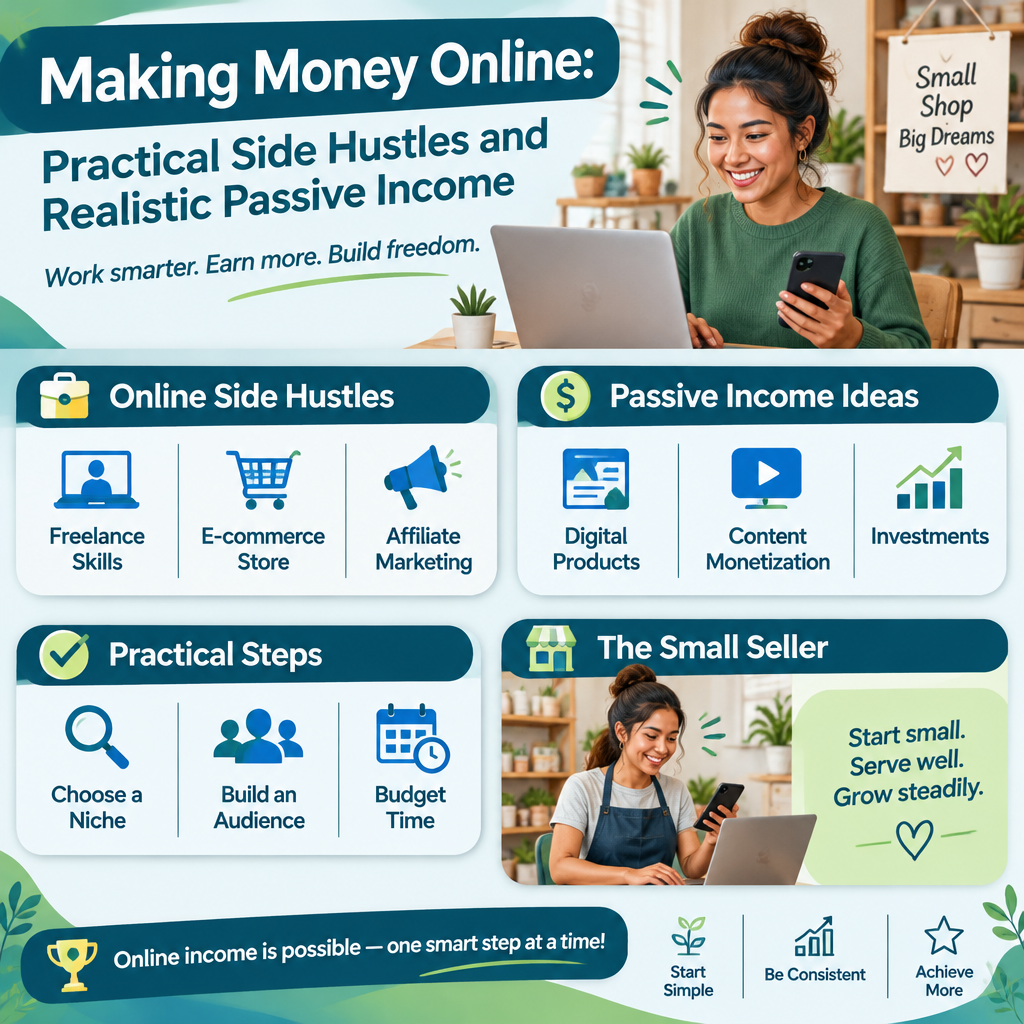
Passive income generally refers to revenue that is not directly tied to every hour of work at the moment it arrives. Examples may include royalties from a book, sales of a digital template, affiliate commissions, advertising on established content, or returns from investments. Each model has distinct costs, risks, rules, and timelines. None is a guaranteed paycheck.
Most so-called passive streams need substantial active work first. A course must be planned, recorded, marketed, and updated; a website needs useful material and a way to attract readers; an online store needs product selection, customer service, and order handling. Automation can reduce repetitive tasks, but it does not remove responsibility for errors, refunds, security, or product quality. Someone still has to mind the machine.
Scalability is the appealing part. A digital file can be sold to more than one customer without recreating it each time, which may improve the return on an hour of initial work. But the model needs customer demand, suitable distribution, and ongoing maintenance. Measure the full cost of producing and selling the asset, then compare lifetime profit with the labor and capital involved. That is a more useful ROI calculation than counting downloads alone.
A sensible progression is to begin with a service, learn what customers repeatedly need, and then build a product that addresses a demonstrated pattern. A freelance writer might create a paid editorial template after clients repeatedly ask for one; a tutor might make practice materials for students. First learn the problem. Then build the asset.
Do not borrow heavily or abandon dependable income because an online personality calls a product “hands-off.” A responsible plan includes realistic sales assumptions, customer support, and an exit point if costs outrun results. Passive income can be one revenue stream in a broader business model, but it usually starts with active effort and remains subject to uncertainty.
Frequently Asked Questions
What is the best side hustle to start?
There is no universal best choice. A good starting point matches a skill you can deliver, a buyer with a clear need, and a schedule you can sustain. Freelance writing, tutoring, virtual assistance, local services, and reselling are options, not guaranteed earners. Test demand with one small offer before buying equipment or inventory.
Can I make money online with no startup cost?
Some services can begin with tools you already own, such as writing, editing, or tutoring online. “No cost” is still a claim to inspect: internet access, time, software, payment fees, training, and taxes may matter. Avoid offers that require upfront payment to access a promised job or guaranteed earnings. Track actual expenses instead of assuming they are zero.
How much can a side hustle earn?
It depends on time, skills, demand, pricing, expenses, and the kind of work. The available information does not establish a typical income figure for these ideas, and earnings can vary widely. Record your revenue, costs, and hours for several weeks, then calculate profit. Be skeptical of screenshots or claims that omit expenses and unsuccessful attempts.
Is passive income truly passive?
Usually not at the start. Digital products, content, and other recurring revenue models may earn without repeating every task for each sale, but they commonly require research, creation, promotion, maintenance, and customer support. Investment income also involves capital and risk. Treat passive income as a business model that may reduce labor per sale, not money without effort or uncertainty.
Final Thought
A useful side hustle does not need to look impressive. It needs to fit your life, solve a real problem, and leave enough profit after costs to justify the time you spend. Starting small is not a lack of ambition; it is a way to learn without placing the household budget on a bet.
Keep the aim plain. If you need cash soon, a service tied to an existing skill may be more practical than waiting for an audience to grow; if you want to test a business, use a modest pilot and listen to paying customers. If your goal is recurring revenue, understand the active work and risks behind the word passive. Build evidence before building overhead.
Review the numbers honestly. A side gig that earns less than expected can still teach useful skills, but it should not be protected from scrutiny just because you have already invested time. Steward your attention and money as carefully as your income. Work is valuable; so are rest, obligations, and the people who depend on you.
FAQPage Schema